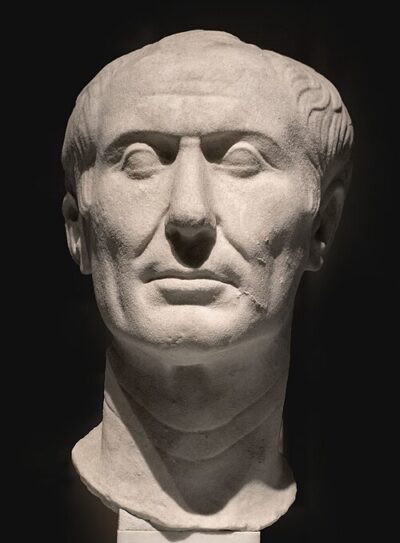
Commentarii de Bello Gallico
Commentarii de Bello Gallico is a commentary on Gallic wars by Julius Caesar. It came out in -58. It was written by Aulus Hirtius.
- Published
- 58 BC
- Written by
- Julius Caesar
- Genre
- non-fiction literature
- Country of origin
- Ancient Rome
All 11 facts, and where they come from
Facts
11 facts · 0 confirmed by two sources · 0 cited · 11 from one source
Where this comes from
Papalocal keeps its own record. It started from these sources; what each one said is kept here as it was copied, so a change on their side never changes this page by itself. Tap one to read its version.
What Wikidata says · copied November 17, 2026 · revision 2541689348
- Described as
- commentary on Gallic wars by Julius Caesar
- Other names
- De Bello Gallico, Bellum Gallicum, The Gallic Wars, Caes. Gal., Hirt. Gal., Gallic Wars, Caes. BGall.
- What it is
- literary work
- Written by
- Aulus Hirtius; Julius Caesar
- Genre
- non-fiction literature; propaganda; autobiography; chronicle
- Published
- 58 BC; 49 BC
- Language
- Latin
- Country of origin
- Ancient Rome
- Followed by
- Commentarii de Bello Civili
- Wikipedias with a page
- 64
Wikidata item Q106199 (wikidata.org/wiki/Q106199), public domain (CC0). Copied 2026-11-17.
What Wikipedia says · copied November 17, 2026 · revision 1384747762
Commentarii de Bello Gallico (Classical Latin: [kɔm.mɛnˈtaː.ɾi.iː deː ˈbɛl.loː ˈɡal.lɪ.koː]; English: Commentaries on the Gallic War), also Bellum Gallicum (English: Gallic War), is Julius Caesar's first-hand account of the Gallic Wars, written as a third-person narrative. In it, Caesar describes the battles and intrigues that took place in the nine years he spent fighting the Celtic and Germanic peoples in Gaul who opposed Roman conquest.
The "Gaul" to which Caesar refers is ambiguous, as the term had various connotations in Roman writing and discourse during Caesar's time. Generally, Gaul included all of the regions primarily inhabited by Celts, aside from the province of Gallia Narbonensis (modern-day Provence and Occitania), which had already been conquered in Caesar's time, therefore encompassing the rest of modern France, Belgium, Western Germany, and parts of Switzerland. As the Roman Republic made inroads deeper into Celtic territory and conquered more land, the definition of "Gaul" shifted. Concurrently, "Gaul" was also used in common parlance as a synonym for "uncouth" or "unsophisticated", as Romans saw Celtic peoples as uncivilized compared with themselves.
Commentarii de Bello Gallico has long been a mainstay in Latin instruction due to its simple, direct prose. It begins with the frequently quoted phrase Gallia est omnis divisa in partes tres, meaning "Gaul is a whole divided into three parts". The full work is split into eight sections, Book 1 to Book 8, varying in size from approximately 5,000 to 15,000 words. Book 8 was written by Aulus Hirtius, after Caesar's death.
Although most contemporaries and subsequent historians considered the account truthful, 20th-century historians have questioned the outlandish claims made in the work. Of particular note are Caesar's claims that the Romans fought Gallic forces of up to 430,000 (a size believed to be impossible for an army at that time), and that the Romans suffered no deaths against this incredibly large force.
From the Wikipedia article “Commentarii de Bello Gallico” (en.wikipedia.org/wiki/Commentarii_de_Bello_Gallico), by its contributors, under CC BY-SA 4.0 (creativecommons.org/licenses/by-sa/4.0/). Copied 2026-11-17; not changed.
Confirmed Two sources agree. Cited One source, and it names where it got it. One source One source, without a reference of its own. Sources disagree The sources disagree. We show the best-supported value and keep theirs below.
Picture: Wikimedia Commons: Caesar bsb beck.jpg · See Commons file page