
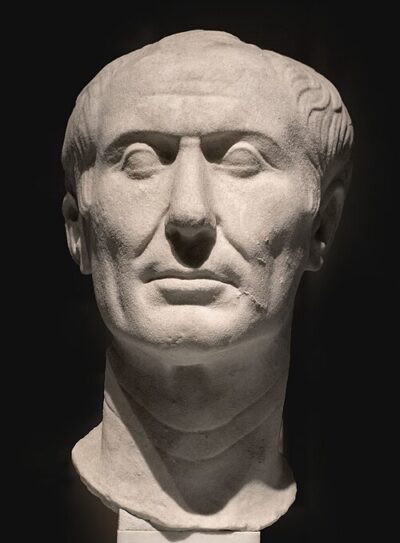
Julius Caesar
Julius Caesar was a Roman general and dictator. Born July 100 BC, in Rome. Died March 15, 44 BC, in Theatre of Pompey. Positions held include Roman dictator (-49–-44), quaestor (-69) and curule aedile (-65). Known for Commentarii de Bello Gallico and Commentarii de Bello Civili. Awards include Roman triumph and Consecratio.
Facts
46 facts · 0 confirmed by two sources · 21 cited · 25 from one source
Where this comes from
Papalocal keeps its own record. It started from these sources; what each one said is kept here as it was copied, so a change on their side never changes this page by itself. Tap one to read its version.
What Wikidata says · copied November 16, 2026 · revision 2569135947
- Described as
- Roman general and dictator
- Other names
- Divine Julius, Iulius Caesar, Gaius Iulius Caesar, Caesar, Gaius Julius Caesar IV, C. Julius Caesar, IVLIVS CAESAR, Dictator Caesar, Divus Julius, Imperator Gaius Julius Gai filius Gai nepos Caesar Patris Patriae, Gaius Julius Gaii filius Gaii nepos Caesar, GAIVS IVLIVS CAESAR
- Born
- July 100 BC · 3 references
- Died
- March 15, 44 BC · 6 references
- Born in
- Rome · 1 reference
- Died in
- Theatre of Pompey · 3 references
- Buried in
- Temple of Caesar · 1 reference
- Cause of death
- bleeding
- Citizen of
- Ancient Rome
- Occupation
- orator; memoirist; ruler · 1 reference; historian · 1 reference; poet · 1 reference; ancient Roman priest; politician · 3 references; military personnel
- Positions held
- Roman dictator (-49–-44); quaestor (-69); curule aedile (-65); ancient Roman senator (–-44) · 1 reference; Roman consul (3 times) (-59–-44) · 1 reference; Flamen Dialis (-84–-81); pontifex (-73–-63); pontifex maximus (-63–-44); Roman governor (2 times) (-61–-49); praetors (-62); moneyer (-49–-44) · 1 reference
- Political party
- populares · 2 references
- Member of
- First Triumvirate
- Known for
- Commentarii de Bello Gallico; Commentarii de Bello Civili
- Awards
- Roman triumph; Consecratio (-44–)
- Spouse
- Cornelia (–-68) · 3 references; Pompeia (-67–-61) · 3 references; Calpurnia (-59–-44) · 3 references
- Children
- Julia · 4 references; Caesarion · 2 references; Augustus · 1 reference
- Father
- Gaius Julius Caesar · 3 references
- Mother
- Aurelia · 3 references
- Siblings
- Julia Major · 3 references; Julia Minor · 3 references
- Religion
- ancient Roman religion
- Military rank
- military tribune (-71); imperator
- Lived in
- Rome
- Wikipedias with a page
- 285
Wikidata item Q1048 (wikidata.org/wiki/Q1048), public domain (CC0). Copied November 16, 2026.
What Wikipedia says · copied November 16, 2026 · revision 1385833445
Gaius Julius Caesar (12 or 13 July 100 BC – 15 March 44 BC) was a Roman general, statesman, and author who was the dictator of the Roman Republic almost continuously from 49 BC until his assassination in 44 BC. A member of the First Triumvirate, he led the Roman armies through the Gallic Wars and defeated his political rival Pompey in Caesar's civil war. He consolidated power and was titled as dictator perpetuo in 44 BC, helping create the political conditions that led to the collapse of the Roman Republic and the emergence of the Roman Empire. For his role in these events, he is regarded as one of history's most influential figures.
In 60 BC, Caesar, Crassus, and Pompey formed the First Triumvirate, an informal political alliance that dominated Roman politics for several years. Their attempts to amass political power were opposed by many in the Senate, including Cato the Younger with the private support of Cicero. Caesar rose to become one of the most powerful politicians in the Roman Republic through a string of military victories in the Gallic Wars, completed by 51 BC, which greatly expanded Roman territory. During this time, he invaded Britain and built a bridge across the Rhine. These achievements, along with the loyalty of his veteran army, threatened to eclipse the standing of Pompey. The alliance between Caesar and Pompey slowly broke down and, by 50 BC, Pompey had realigned himself with the Senate. With his command expiring and the Gallic Wars largely concluded, the Senate ordered Caesar to relinquish his military command and return to Rome. In early January 49 BC, Caesar openly defied the Senate by crossing the Rubicon and marching towards Rome at the head of an army. This act began Caesar's civil war, which he won, leaving him in a position of near-unchallenged power and influence in 45 BC.
After assuming control of government and pardoning many of his enemies, Caesar carried out various reforms and public works. He created the Julian calendar to replace the republican lunisolar calendar, reduced the size of the grain dole, settled his veterans in new overseas colonies, greatly increased the size of the Senate, and extended citizenship to communities in Spain and what is now northern Italy. In early 44 BC, he was proclaimed "dictator in perpetuity". Fearful of his power, his domination of the state, and the possibility that he might make himself king, a group of senators led by Brutus and Cassius assassinated Caesar on the Ides of March (15 March) 44 BC. A new series of civil wars broke out and the constitutional government of the Republic was never fully restored. Caesar's great-nephew and adoptive heir Octavian, later known as Augustus, rose to sole power after defeating his opponents thirteen years later. Octavian then set about consolidating his power, transforming the Republic into the Roman Empire as its first emperor.
Caesar was an accomplished author and commentator; much of his life is known through his own accounts of his military campaigns. Other contemporary sources include the letters and speeches of Cicero and the historical writings of Sallust. Later biographies of Caesar by Suetonius and Plutarch are also important sources. Caesar is considered by many historians to be one of the greatest military commanders in history. His cognomen subsequently became a synonym for emperor; the title Caesar was used throughout the Roman Empire, and gave rise to modern derivatives such as Kaiser and Tsar. He has frequently appeared in literary and artistic works.
From the Wikipedia article “Julius Caesar” (en.wikipedia.org/wiki/Julius_Caesar), by its contributors, under CC BY-SA 4.0 (creativecommons.org/licenses/by-sa/4.0/). Copied November 16, 2026; not changed.
Confirmed Two sources agree. Cited One source, and it names where it got it. One source One source, without a reference of its own. Sources disagree The sources disagree. We show the best-supported value and keep theirs below.
