Commentariolus
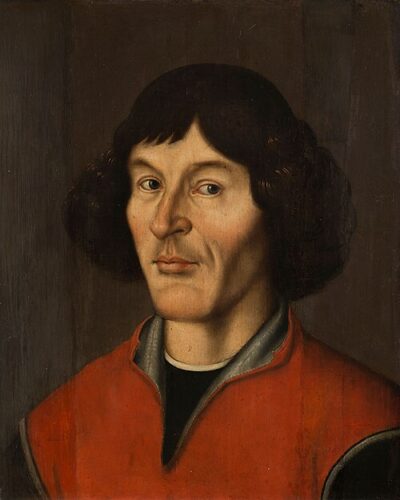
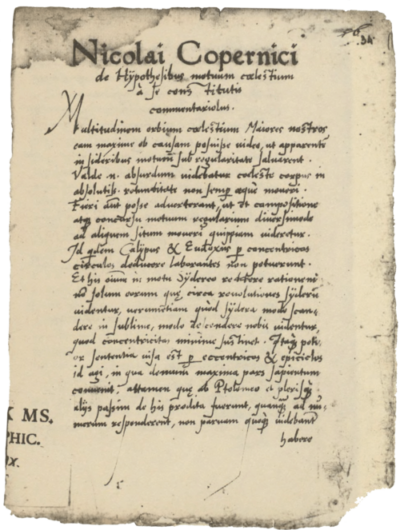
Commentariolus is a work by Copernicus. It was written by Nicolaus Copernicus.
- Written by
- Nicolaus Copernicus
All 3 facts, and where they come from
Facts
3 facts · 0 confirmed by two sources · 1 cited · 2 from one source
Where this comes from
Papalocal keeps its own record. It started from these sources; what each one said is kept here as it was copied, so a change on their side never changes this page by itself. Tap one to read its version.
What Wikidata says · copied November 17, 2026 · revision 2486759789
- Described as
- work by Copernicus
- What it is
- manuscript
- Written by
- Nicolaus Copernicus · 1 reference
- Language
- Latin
- Wikipedias with a page
- 17
Wikidata item Q675765 (wikidata.org/wiki/Q675765), public domain (CC0). Copied 2026-11-17.
What Wikipedia says · copied November 17, 2026 · revision 1384264541
The Commentariolus (Little Commentary) is Nicolaus Copernicus's brief outline of an early version of his revolutionary heliocentric theory of the universe. After further long development of his theory, Copernicus published the mature version in 1530 in his landmark work, De revolutionibus orbium coelestium (On the Revolutions of the Heavenly Spheres).
Copernicus wrote the Commentariolus in Latin by 1514 and circulated copies to his friends and colleagues. It thus became known among Copernicus's contemporaries, though it was never printed during his lifetime. In 1533, Johann Albrecht Widmannstetter delivered a series of lectures in Rome outlining Copernicus' theory. Pope Clement VII and several Catholic cardinals heard the lectures and were interested in the theory. On 1 November 1536, Nikolaus von Schönberg, Archbishop of Capua and since the preceding year a cardinal, wrote to Copernicus from Rome and asked him for a copy of his writings "at the earliest possible moment".
Although copies of the Commentariolus circulated for a time after Copernicus's death, it subsequently lapsed into obscurity, and its previous existence remained known only indirectly, until a surviving manuscript copy was discovered and published in the second half of the nineteenth century.
From the Wikipedia article “Commentariolus” (en.wikipedia.org/wiki/Commentariolus), by its contributors, under CC BY-SA 4.0 (creativecommons.org/licenses/by-sa/4.0/). Copied 2026-11-17; not changed.
Confirmed Two sources agree. Cited One source, and it names where it got it. One source One source, without a reference of its own. Sources disagree The sources disagree. We show the best-supported value and keep theirs below.
Picture: Unknown author, via Wikimedia Commons · Public domain