
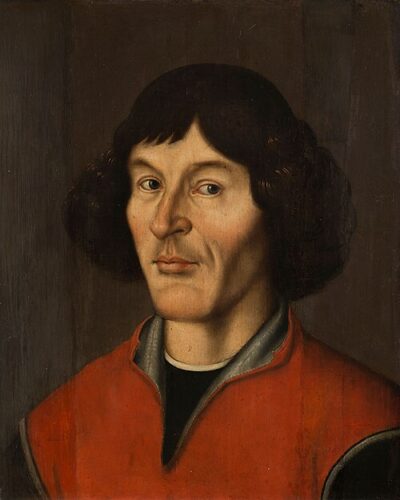
Nicolaus Copernicus
Nicolaus Copernicus was a Polish mathematician and astronomer. Born February 19, 1473, in Toruń. Died May 24, 1543, in Frombork. Known for Commentariolus and De revolutionibus orbium coelestium. Educated at Jagiellonian University and University of Padua. Awards include International Space Hall of Fame.
Facts
40 facts · 2 confirmed by two sources · 12 cited · 26 from one source
Where this comes from
Papalocal keeps its own record. It started from these sources; what each one said is kept here as it was copied, so a change on their side never changes this page by itself. Tap one to read its version.
What Wikidata says · copied November 16, 2026 · revision 2568293413
- Described as
- Polish mathematician and astronomer (1473-1543)
- Other names
- Mikołaj Kopernik, Copernicus, Nikolaus Kopernikus, Niklas Koppernigk, Kopernikus
- Born
- February 19, 1473 · 5 references
- Died
- May 24, 1543 · 5 references
- Born in
- Toruń · 7 references
- Died in
- Frombork · 7 references
- Buried in
- Archcathedral Basilica of the Assumption of the Blessed Virgin Mary and Saint Andrew in Frombork
- Cause of death
- stroke
- Name at birth
- Niklas Koppernigk
- Citizen of
- Kingdom of Poland · 1 reference; statelessness · 2 references; Royal Prussia
- Occupation
- astronomer · 4 references; jurist · 1 reference; economist; mathematician · 5 references; legal scholar; physicist; philosopher · 2 references; translator
- Worked for
- University of Padua; Jagiellonian University · 1 reference
- Education
- Jagiellonian University (1491–1495) · 2 references; University of Padua (1501–1503); University of Bologna (1496–1500); University of Ferrara (1503)
- Known for
- Commentariolus · 1 reference; De revolutionibus orbium coelestium · 1 reference
- Awards
- International Space Hall of Fame (1995) · 2 references
- Field
- astronomy; mathematics; mechanics; economics
- Father
- Niklas Koppernigk the Elder · 1 reference
- Mother
- Barbara Koppernigk · 1 reference
- Religion
- Catholicism; Catholic Church
- Lived in
- Toruń; Frombork; Kraków; Padua; Bologna
- Wikipedias with a page
- 215
Wikidata item Q619 (wikidata.org/wiki/Q619), public domain (CC0). Copied November 16, 2026.
What Wikipedia says · copied November 16, 2026 · revision 1385564497
Nicolaus Copernicus (19 February 1473 – 24 May 1543) was a Renaissance polymath who formulated a model of the universe that placed the Sun rather than Earth at its center. The publication of Copernicus's model in his book De revolutionibus orbium coelestium (On the Revolutions of the Celestial Spheres), just before his death in 1543, was a major event in the history of science, triggering the Copernican Revolution and making a pioneering contribution to the Scientific Revolution. Though a similar heliocentric model had been developed eighteen centuries earlier by Aristarchus of Samos, an ancient Greek astronomer, Copernicus likely arrived at his model independently.
Copernicus was born and died in Royal Prussia, a semi-autonomous and multilingual region created within the Crown of the Kingdom of Poland from lands regained from the Teutonic Order after the Thirteen Years' War.
A polyglot and polymath, he obtained a doctorate in canon law and was a mathematician, astronomer, physician, classics scholar, translator, governor, diplomat, and economist. From 1497 he was a Warmian Cathedral chapter canon. In 1517 he derived a quantity theory of money—a key concept in economics—and in 1519 he formulated an economic principle that later came to be called Gresham's law.
- Born, in its opening lines
- February 19, 1473
- Died, in its opening lines
- May 24, 1543
From the Wikipedia article “Nicolaus Copernicus” (en.wikipedia.org/wiki/Nicolaus_Copernicus), by its contributors, under CC BY-SA 4.0 (creativecommons.org/licenses/by-sa/4.0/). Copied November 16, 2026; not changed.
Confirmed Two sources agree. Cited One source, and it names where it got it. One source One source, without a reference of its own. Sources disagree The sources disagree. We show the best-supported value and keep theirs below.
