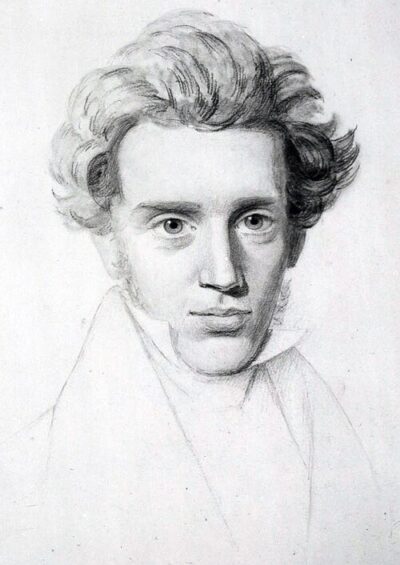
Concluding Unscientific Postscript to Philosophical Fragments
Concluding Unscientific Postscript to Philosophical Fragments is an essay by Søren Kierkegaard. It came out in 1846.
- Published
- 1846
- Written by
- Søren Kierkegaard
- Genre
- essay
- Country of origin
- Denmark
All 8 facts, and where they come from
Facts
8 facts · 0 confirmed by two sources · 0 cited · 8 from one source
Where this comes from
Papalocal keeps its own record. It started from these sources; what each one said is kept here as it was copied, so a change on their side never changes this page by itself. Tap one to read its version.
What Wikidata says · copied November 17, 2026 · revision 2553406196
- Described as
- essay by Søren Kierkegaard
- What it is
- written work
- Written by
- Søren Kierkegaard
- Genre
- essay · 1 reference
- Published
- 1846
- Language
- Danish
- Country of origin
- Denmark · 1 reference
- Comes after
- Stages on Life's Way
- Followed by
- Two Ages: A Literary Review · 1 reference
- Wikipedias with a page
- 9
Wikidata item Q849447 (wikidata.org/wiki/Q849447), public domain (CC0). Copied 2026-11-17.
What Wikipedia says · copied November 17, 2026 · revision 1384254341
Concluding Unscientific Postscript to the Philosophical Fragments (Danish: Afsluttende uvidenskabelig Efterskrift til de philosophiske Smuler, more accurately translated as Concluding Unscientific Postscript to the Philosophical Crumbs) is a major work by Søren Kierkegaard. The work is an attack against Hegelianism, the philosophy of Hegel, and particularly Hegel's Science of Logic. The work is also famous for its dictum, "subjectivity is truth". It was an attack on what Kierkegaard saw as Hegel's deterministic philosophy. Against Hegel's system, Kierkegaard is often interpreted as taking the side of metaphysical libertarianism or free will, though it has been argued that an incompatibilist conception of free will is not essential to Kierkegaard's formulation of existentialism.
Concluding Unscientific Postscript to the Philosophical Fragments is a sequel to the earlier Philosophical Fragments. Despite the title of the work, Postscript is almost five times larger than the original work. The pseudonym "Johannes Climacus" is credited as the author and Kierkegaard as an editor. Like his other pseudonymous works, Postscript is not a reflection of Kierkegaard's own beliefs. However, unlike his other pseudonymous works, Kierkegaard attaches his name to this work by crediting himself as an editor.
From the Wikipedia article “Concluding Unscientific Postscript to Philosophical Fragments” (en.wikipedia.org/wiki/Concluding_Unscientific_Postscript_to_Philosophical_Fragments), by its contributors, under CC BY-SA 4.0 (creativecommons.org/licenses/by-sa/4.0/). Copied 2026-11-17; not changed.
Confirmed Two sources agree. Cited One source, and it names where it got it. One source One source, without a reference of its own. Sources disagree The sources disagree. We show the best-supported value and keep theirs below.
Picture: Wikimedia Commons: Concluding Unscientific Postscript to Philosophical Fragments.jpg · See Commons file page