
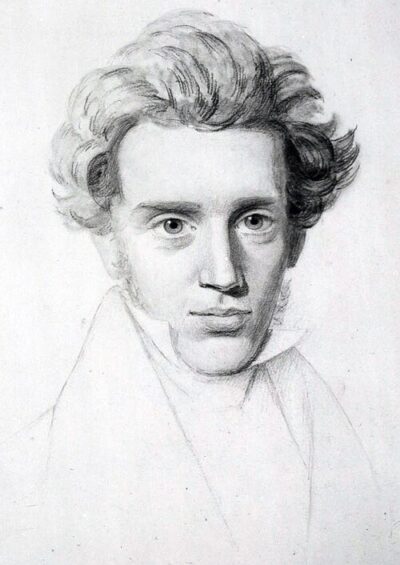
Søren Kierkegaard
Søren Kierkegaard was a Danish theologian, philosopher, poet and social critic. Born May 5, 1813, in Copenhagen. Died November 11, 1855, in Copenhagen. Known for Either/Or, Fear and Trembling and The Concept of Anxiety. Educated at University of Copenhagen and Østre Borgerdyd school.
Facts
38 facts · 2 confirmed by two sources · 9 cited · 26 from one source · 1 where the sources disagree
What’s different
- Cause of death: we show paralysis (Sources disagree). Wikidata also lists tuberculosis
Where this comes from
Papalocal keeps its own record. It started from these sources; what each one said is kept here as it was copied, so a change on their side never changes this page by itself. Tap one to read its version.
What Wikidata says · copied November 16, 2026 · revision 2563341059
- Described as
- Danish theologian, philosopher, poet and social critic (1813–1855)
- Other names
- Kierkegaard, Victor Eremita, Climacus, Anti-Climacus, Sören Aaby Kierkegaard, Søren Aabye Kierkegaard
- Born
- May 5, 1813 · 17 references
- Died
- November 11, 1855 · 17 references
- Born in
- Copenhagen · 3 references
- Died in
- Copenhagen · 3 references
- Buried in
- Assistens Cemetery
- Cause of death
- tuberculosis; paralysis · 1 reference
- Name at birth
- Søren Aabye Kierkegaard
- Citizen of
- Kingdom of Denmark
- Occupation
- philosopher · 4 references; theologian · 4 references; poet · 1 reference; novelist; literary critic
- Education
- University of Copenhagen; Østre Borgerdyd school
- Genre
- polemical lampoon; debate; diary
- Known for
- Either/Or; Fear and Trembling; The Concept of Anxiety; The Book on Adler; Christian Discourses; Works of Love; The Sickness Unto Death; On the Concept of Irony with Continual Reference to Socrates; Stages on Life's Way; Concluding Unscientific Postscript to Philosophical Fragments
- Field
- philosophy; theology · 1 reference; poetry · 1 reference; social criticism · 1 reference; creative and professional writing · 1 reference
- Father
- Michael Pedersen Kierkegaard
- Siblings
- Peter Kierkegaard
- Religion
- Lutheranism
- Lived in
- Copenhagen; Berlin
- Wikipedias with a page
- 171
Wikidata item Q6512 (wikidata.org/wiki/Q6512), public domain (CC0). Copied November 16, 2026.
What Wikipedia says · copied November 16, 2026 · revision 1385635537
Søren Aabye Kierkegaard ( SORR-ən KEER-kə-gard, US also -gor; Danish: [ˈsɶːɐn ˈɔˀˌpyˀ ˈkʰiɐ̯kəˌkɒːˀ] ; 5 May 1813 – 11 November 1855) was a Danish philosopher, Christian theologian, poet, social critic, and religious author who is widely considered to be the first existentialist philosopher. He wrote critical texts on organized religion, Christianity, morality, ethics, psychology, love, and the philosophy of religion, displaying a fondness for metaphor, irony, and parables. Much of his philosophical work deals with the issues around how one lives as a "single individual", highlighting the importance of authenticity, personal choice and commitment, and the duty to love. Kierkegaard prioritized concrete human reality over abstract thinking.
Kierkegaard's theological work focuses on Socratic Christian ethics, the institution of the Church, the differences among purely objective proofs of Christianity, the infinite qualitative distinction between man and God, and the individual's subjective relationship to the God-Man Jesus Christ, which came through faith. Much of his work deals with Christian love. He was extremely critical of the doctrine and practice of Christianity as a state-controlled religion (Caesaropapism), like the Church of Denmark. His psychological work explored the emotions and feelings of individuals when faced with life choices. Unlike Jean-Paul Sartre and the atheistic existentialism paradigm, Kierkegaard focused on Christian existentialism.
Kierkegaard's early work was written using pseudonyms, who presented distinctive viewpoints and interacted in complex dialogue. He wrote Upbuilding Discourses under his own name and dedicated them to the "single individual" who might want to discover the meaning of his works. He wrote: "Science and scholarship want to teach that becoming objective is the way. Christianity teaches that the way is to become subjective, to become a subject." Kierkegaard emphatically denied that observation alone could reveal the inner workings of the world of the spirit.
Some of Kierkegaard's key ideas include the concept of "subjective and objective truths", the knight of faith, the recollection and repetition dichotomy, angst, the infinite qualitative distinction, faith as a passion, and the three stages on life's way. Kierkegaard wrote in Danish and the reception of his work was initially limited to Scandinavia, but by the turn of the 20th century his writings were translated into French, German, and other major European languages. By the middle of the 20th century, his thought exerted a substantial influence on philosophy, theology, and Western culture in general.
- Born, in its opening lines
- May 5, 1813
- Died, in its opening lines
- November 11, 1855
From the Wikipedia article “Søren Kierkegaard” (en.wikipedia.org/wiki/Søren_Kierkegaard), by its contributors, under CC BY-SA 4.0 (creativecommons.org/licenses/by-sa/4.0/). Copied November 16, 2026; not changed.
Confirmed Two sources agree. Cited One source, and it names where it got it. One source One source, without a reference of its own. Sources disagree The sources disagree. We show the best-supported value and keep theirs below.
