Cosmos
Cosmos is a 1845 essay by Alexander von Humboldt.
- Published
- 1845
- Written by
- Alexander von Humboldt
- Genre
- essay
All 6 facts, and where they come from
Facts
6 facts · 0 confirmed by two sources · 0 cited · 6 from one source
Where this comes from
Papalocal keeps its own record. It started from these sources; what each one said is kept here as it was copied, so a change on their side never changes this page by itself. Tap one to read its version.
What Wikidata says · copied November 17, 2026 · revision 2522760352
- Described as
- 1845 essay by Alexander von Humboldt
- Other names
- Kosmos – Entwurf einer physischen Weltbeschreibung, Kosmos, Cosmos: A Sketch of a Physical Description of the Universe
- What it is
- literary work; creative work
- Written by
- Alexander von Humboldt
- Genre
- essay
- Published
- 1845
- Language
- German · 1 reference
- Wikipedias with a page
- 15
Wikidata item Q584294 (wikidata.org/wiki/Q584294), public domain (CC0). Copied 2026-11-17.
What Wikipedia says · copied November 17, 2026 · revision 1386089290
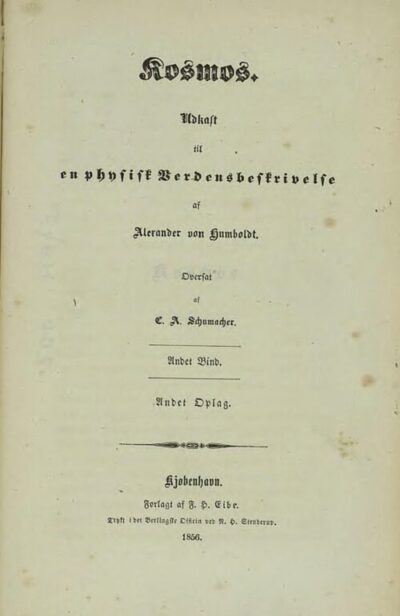
Cosmos: A Sketch of a Physical Description of the Universe (in German Kosmos – Entwurf einer physischen Weltbeschreibung) is an influential treatise on science and nature written by the German scientist and explorer Alexander von Humboldt. It began as a lecture series delivered by Humboldt at the University of Berlin, and was published in five volumes between 1845 and 1862 (the fifth was posthumous and completed based on Humboldt's notes). In the first volume, Humboldt paints a general "portrait of nature", describing the physical nature of outer space and the Earth. In the second volume he describes the history of science.
Widely read by academics and laymen, Cosmos applies the ancient Greek view of the orderliness of the cosmos (the harmony of the universe) to the Earth, suggesting that universal laws apply as well to the apparent chaos of the terrestrial world and that contemplation of nature can yield an awareness of its wholeness and coherence. Humboldt embraced the subjectivity of the observer and "thus ran exactly counter to the developing ideology of science, the objectivity which sought to purify science by removing subjectivity altogether".
Cosmos was influenced by Humboldt's travels and studies, but mainly by his journey throughout the Americas. As he wrote, “it was the discovery of America that planted the seed of the Cosmos.” Due to all of his experience in the field, Humboldt was preeminently qualified for the task to represent the universe in a single work. He had extensive knowledge of many fields of learning, varied experiences as a traveler, and the resources of the scientific and literary world at his disposal.
Cosmos was highly popular when it was released, with the first volume selling out in two months, and the work translated into most European languages. Humboldt wrote in his journal further sketches of volumes of Cosmos titled as Cosmos 1 through 9. These volumes were left with only their draft titles and half-written till Humboldt's death in 1859. Although the natural sciences have diverged from the romantic perspective Humboldt presented in Cosmos, the work is still considered a substantial scientific and literary achievement, having influenced subsequent scientific progress and imparted a unifying perspective to the studies of science, nature and mankind.
From the Wikipedia article “Cosmos (Humboldt book)” (en.wikipedia.org/wiki/Cosmos_(Humboldt_book)), by its contributors, under CC BY-SA 4.0 (creativecommons.org/licenses/by-sa/4.0/). Copied 2026-11-17; not changed.
Confirmed Two sources agree. Cited One source, and it names where it got it. One source One source, without a reference of its own. Sources disagree The sources disagree. We show the best-supported value and keep theirs below.
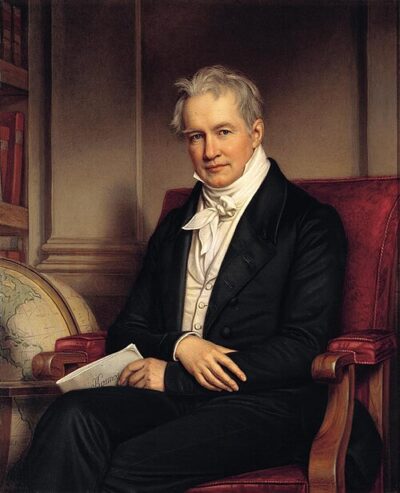
Picture: Alexander von Humboldt, via Wikimedia Commons · Public domain