
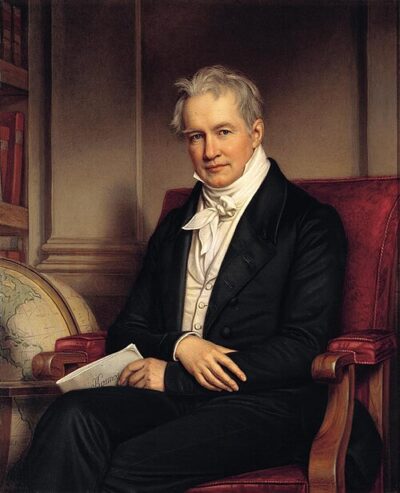
Alexander von Humboldt
Alexander von Humboldt was a Prussian geographer, naturalist and explorer. Born September 14, 1769, in Berlin. Died May 6, 1859, in Berlin. Positions held include Geheimrat. Known for Aspects of nature and Cosmos. Educated at University of Frankfurt an der Oder and Freiberg University of Mining and Technology. Awards include Merit Order of the Bavarian Crown, Imperial Order of the Rose and Grand Cross of the Order of the Dannebrog.
Facts
59 facts · 2 confirmed by two sources · 16 cited · 41 from one source
Where this comes from
Papalocal keeps its own record. It started from these sources; what each one said is kept here as it was copied, so a change on their side never changes this page by itself. Tap one to read its version.
What Wikidata says · copied November 16, 2026 · revision 2568726033
- Described as
- Prussian geographer, naturalist and explorer (1769–1859)
- Other names
- Humboldt, Von Humboldt, Alexander, Freiherr von Humboldt, Alexander von Freiherr Humboldt, M. de Humboldt, Friedrich Heinrich Alex., Baron von Humboldt, Alexander Freiherr Von Humboldt, Alexander Freiherr von Humboldt, Friedrich Heinrich Alexander von Humboldt, De Humboldt, Humb., Friedrich Wilhelm Heinrich Alexander von Humboldt
- Born
- September 14, 1769 · 23 references
- Died
- May 6, 1859 · 21 references
- Born in
- Berlin · 6 references
- Died in
- Berlin · 4 references
- Buried in
- the Humboldt family’s burial place · 1 reference
- Citizen of
- Kingdom of Prussia · 1 reference
- Occupation
- geologist · 1 reference; explorer · 1 reference; botanist; geographer · 2 references; oceanographer; volcanologist; travel writer; meteorologist · 1 reference
- Positions held
- Geheimrat · 1 reference
- Worked for
- University of Jena
- Education
- University of Frankfurt an der Oder; Freiberg University of Mining and Technology; University of Göttingen · 1 reference; University of Jena
- Member of
- Royal Society of London (1815–); German Academy of Sciences Leopoldina; Royal Prussian Academy of Sciences; Bavarian Academy of Sciences and Humanities; Academy of Science for Public Utility; Göttingen Academy of Sciences and Humanities in Lower Saxony; Royal Netherlands Academy of Arts and Sciences; Hungarian Academy of Sciences; Naturforschende Gesellschaft in Danzig; Royal Swedish Academy of Sciences
- Known for
- Aspects of nature; Cosmos
- Awards
- Merit Order of the Bavarian Crown; Imperial Order of the Rose; Grand Cross of the Order of the Dannebrog; Grand Cross of the Legion of Honour · 1 reference; Mexican Imperial Orders; Grand Cross of the Order of Christ; Order of St. Vladimir, 1st class; Order of the White Falcon; Knight Grand Cross of the Order of Saints Maurice and Lazarus; Grand Cross of the Order of Charles III; Bavarian Maximilian Order for Science and Art (1853); Copley Medal (1852) · 1 reference; Pour le Mérite for Sciences and Arts order; Knight of the Order of St. Alexander Nevsky; honorary citizen of Berlin
- Field
- geobotany; economic geography; geography; meteorology; botany; zoology
- Father
- Alexander Georg von Humboldt · 1 reference
- Mother
- Marie-Elisabeth von Humboldt · 1 reference
- Siblings
- Wilhelm von Humboldt · 1 reference
- Religion
- Lutheranism
- Lived in
- rue Jacob (1798–); New Chambers · 1 reference
- Wikipedias with a page
- 141
Wikidata item Q6694 (wikidata.org/wiki/Q6694), public domain (CC0). Copied November 16, 2026.
What Wikipedia says · copied November 16, 2026 · revision 1384688818
Friedrich Wilhelm Heinrich Alexander von Humboldt (14 September 1769 – 6 May 1859) was a German polymath, geographer, naturalist, explorer, and proponent of Romantic philosophy and science. He was the younger brother of the Prussian minister, philosopher, and linguist Wilhelm von Humboldt (1767–1835). Humboldt's quantitative work on botanical geography laid the foundation for the field of biogeography, while his advocacy of long-term systematic geophysical measurement pioneered modern geomagnetic and meteorological monitoring. Humboldt and Carl Ritter are both regarded as the founders of modern geography as they established it as an independent scientific discipline.
Between 1799 and 1804, Humboldt travelled extensively in the Americas, exploring and describing them for the first time from a non-Spanish European scientific point of view. On these travels, along with French explorer Aimé Bonpland, he traversed thousands of miles through some of the most difficult and little-known places on Earth, to include identifying the source of the Orinoco River and in 1802 climbing the highest mountain in Ecuador to a height of 19,286 feet, at the time a world record altitude for a Westerner. His description of the journey was written up and published in several volumes over 21 years.
Humboldt resurrected the use of the word cosmos from the ancient Greek and assigned it to his multivolume treatise, Kosmos, in which he sought to unify diverse branches of scientific knowledge and culture. This important work also motivated a holistic perception of the universe as one interacting entity, which introduced concepts of ecology leading to ideas of environmentalism. In 1800, and again in 1831, he described scientifically, on the basis of observations generated during his travels, local impacts of development causing human-induced climate change.
Humboldt is seen as "the father of ecology" and "the father of environmentalism".
- Born, in its opening lines
- September 14, 1769
- Died, in its opening lines
- May 6, 1859
From the Wikipedia article “Alexander von Humboldt” (en.wikipedia.org/wiki/Alexander_von_Humboldt), by its contributors, under CC BY-SA 4.0 (creativecommons.org/licenses/by-sa/4.0/). Copied November 16, 2026; not changed.
Confirmed Two sources agree. Cited One source, and it names where it got it. One source One source, without a reference of its own. Sources disagree The sources disagree. We show the best-supported value and keep theirs below.
