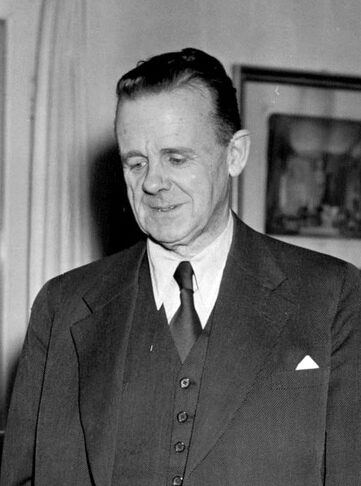
Cramér's conjecture
Cramér's conjecture is a conjecture.
All 2 facts, and where they come from
Facts
2 facts · 0 confirmed by two sources · 0 cited · 2 from one source
Where this comes from
Papalocal keeps its own record. It started from these sources; what each one said is kept here as it was copied, so a change on their side never changes this page by itself. Tap one to read its version.
What Wikidata says · copied November 18, 2026 · revision 2567901032
- Described as
- conjecture
- What it is
- conjecture
- Named after
- Harald Cramér
- Wikipedias with a page
- 14
Wikidata item Q515591 (wikidata.org/wiki/Q515591), public domain (CC0). Copied 2026-11-18.
What Wikipedia says · copied November 18, 2026 · revision 1382185128
In number theory, Cramér's conjecture, formulated by the Swedish mathematician Harald Cramér in 1936, is an estimate for the size of gaps between consecutive prime numbers: intuitively, that gaps between consecutive primes are always small, and the conjecture quantifies asymptotically just how small they must be. It states that
pn+1−pn=O((logpn)2),
where pn denotes the nth prime number, O is big O notation, and "log" is the natural logarithm. While this is the statement explicitly conjectured by Cramér, his heuristic actually supports the stronger statementlim supn→∞pn+1−pn(logpn)2=1,
or equivalently, for every ϵ > 0, there exists a bound B(ϵ) such thatpn+1−pn<(1+ϵ)(logpn)2for all pn≥B(ϵ)
and sometimes this formulation is called Cramér's conjecture. However, this stronger version is not supported by more accurate heuristic models, which nevertheless support the first version of Cramér's conjecture.
The strongest form of all, which was never claimed by Cramér but is the one used in experimental verification computations and the plot in this article, is simplypn+1−pn<(logpn)2.
None of the three forms have yet been proven or disproven.
From the Wikipedia article “Cramér's conjecture” (en.wikipedia.org/wiki/Cramér's_conjecture), by its contributors, under CC BY-SA 4.0 (creativecommons.org/licenses/by-sa/4.0/). Copied 2026-11-18; not changed.
Confirmed Two sources agree. Cited One source, and it names where it got it. One source One source, without a reference of its own. Sources disagree The sources disagree. We show the best-supported value and keep theirs below.