
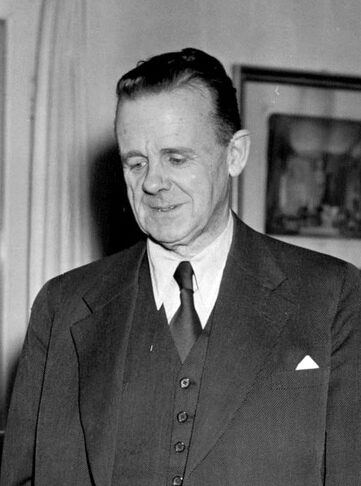
Harald Cramér
Harald Cramér was a Swedish mathematician. Born September 25, 1893, in Hedvig Eleonora parish. Died October 5, 1985, in Hedvig Eleonora and Oscar Parish. Known for Cramér–Rao bound, Cramér's conjecture and Cramér's theorem. Educated at Stockholm University. Awards include Fellow of the Institute of Mathematical Statistics, honorary doctorate from Princeton University and honorary doctorate of the University of Copenhagen.
Facts
41 facts · 2 confirmed by two sources · 11 cited · 28 from one source
Where this comes from
Papalocal keeps its own record. It started from these sources; what each one said is kept here as it was copied, so a change on their side never changes this page by itself. Tap one to read its version.
What Wikidata says · copied November 18, 2026 · revision 2557910004
- Described as
- Swedish mathematician (1893–1985)
- Other names
- Harald Cramer, Carl Harald Cramér
- Born
- September 25, 1893 · 7 references
- Died
- October 5, 1985 · 6 references
- Born in
- Hedvig Eleonora parish · 1 reference
- Died in
- Hedvig Eleonora and Oscar Parish
- Buried in
- Djursholms Begravningsplats · 1 reference
- Name at birth
- Carl Harald Cramér
- Citizen of
- Sweden
- Occupation
- mathematician · 1 reference; actuary; university teacher; statistician · 1 reference
- Worked for
- Stockholm University (1917–1958) · 1 reference
- Education
- Stockholm University (1912–1917) · 1 reference
- Member of
- Royal Swedish Academy of Sciences; Royal Swedish Academy of Engineering Sciences; American Academy of Arts and Sciences; National Academy of Sciences (1984–); Institute of Mathematical Statistics (1946–) · 1 reference
- Known for
- Cramér–Rao bound; Cramér's conjecture; Cramér's theorem; Cramér–Wold theorem; Cramér's theorem (large deviations); Cramér–von Mises criterion; ruin theory; Cramér's V
- Awards
- Fellow of the Institute of Mathematical Statistics (1946) · 1 reference; honorary doctorate from Princeton University (1947) · 1 reference; honorary doctorate of the University of Copenhagen (1950) · 1 reference; honorary doctor of Stockholm University (1964) · 1 reference; Guy Medal in Gold (1972); doctor honoris causa from the Pierre and Marie Curie University (1977) · 1 reference; Knight Grand Officer of the Order of the Polar Star; Fellow of the American Statistical Association; Officer of the Legion of Honour
- Field
- probability theory; mathematics · 1 reference; statistics · 1 reference; mathematical statistics · 1 reference
- Children
- Tomas Cramér · 1 reference; Kim Cramér
- Wikipedias with a page
- 23
Wikidata item Q471777 (wikidata.org/wiki/Q471777), public domain (CC0). Copied November 18, 2026.
What Wikipedia says · copied November 18, 2026 · revision 1385963952
Harald Cramér (Swedish: [kraˈmeːr]; 25 September 1893 – 5 October 1985) was a Swedish mathematician, actuary, and statistician, specializing in mathematical statistics and probabilistic number theory. John Kingman described him as "one of the giants of statistical theory".
- Born, in its opening lines
- September 25, 1893
- Died, in its opening lines
- October 5, 1985
From the Wikipedia article “Harald Cramér” (en.wikipedia.org/wiki/Harald_Cramér), by its contributors, under CC BY-SA 4.0 (creativecommons.org/licenses/by-sa/4.0/). Copied November 18, 2026; not changed.
Confirmed Two sources agree. Cited One source, and it names where it got it. One source One source, without a reference of its own. Sources disagree The sources disagree. We show the best-supported value and keep theirs below.
