Das Rheingold
Das Rheingold is a 1869 opera by Richard Wagner. It came out in 1852. It is based on Norse mythology.
- Released
- 19th century
- Came out
- 1852
- Genre
- opera
All 7 facts, and where they come from
Facts
7 facts · 0 confirmed by two sources · 2 cited · 5 from one source
Where this comes from
Papalocal keeps its own record. It started from these sources; what each one said is kept here as it was copied, so a change on their side never changes this page by itself. Tap one to read its version.
What Wikidata says · copied November 17, 2026 · revision 2483384634
- Described as
- 1869 opera by Richard Wagner
- Other names
- The Rhinegold
- What it is
- dramatico-musical work
- Music by
- Richard Wagner · 1 reference
- Genre
- opera · 1 reference
- Released
- 19th century
- Language
- German
- Based on
- Norse mythology
- Came out
- 1852 · 1 reference
- Wikipedias with a page
- 40
Wikidata item Q327717 (wikidata.org/wiki/Q327717), public domain (CC0). Copied 2026-11-17.
What Wikipedia says · copied November 17, 2026 · revision 1382136519
Das Rheingold (German: [das ˈʁaɪnɡɔlt] ; The Rhinegold), WWV 86A, is the first of the four epic music dramas that constitute Richard Wagner's cycle Der Ring des Nibelungen (English: The Ring of the Nibelung). It premiered as a single opera at the National Theatre of Munich on 22 September 1869, and received its first performance as part of the Ring cycle at the Bayreuth Festspielhaus on 13 August 1876.
Wagner wrote the Ring librettos in reverse order, so that Das Rheingold was the last of the texts to be written; it was, however, the first to be set to music. The score was completed in 1854, but Wagner was unwilling to sanction its performance until the whole cycle was complete; he worked intermittently on this music until 1874. The 1869 Munich premiere of Das Rheingold was staged, against Wagner's wishes, on the orders of King Ludwig II of Bavaria, his patron. Following its 1876 Bayreuth premiere, the Ring cycle was introduced into the worldwide repertory, with performances in all the main opera houses, in which it has remained a regular and popular fixture.
In his 1851 essay Opera and Drama, Wagner had set out new principles as to how music dramas should be constructed, under which the conventional forms of opera (arias, ensembles, choruses) were rejected. Rather than providing word-settings, the music would interpret the text emotionally, reflecting the feelings and moods behind the work, by using a system of recurring leitmotifs to represent people, ideas and situations. Das Rheingold was Wagner's first work that adopted these principles, and his most rigid adherence to them, despite a few deviations – the Rhinemaidens frequently sing in ensemble.
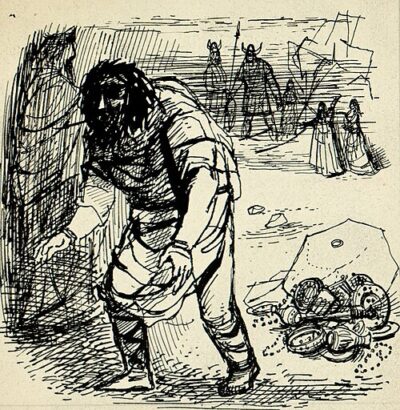
As the "preliminary evening" within the cycle, Das Rheingold gives the background to the events that drive the main dramas of the cycle. It recounts Alberich's theft of the Rhine gold after his renunciation of love; his fashioning of the all-powerful ring from the gold and his enslavement of the Nibelungs; Wotan's seizure of the gold and the ring, to pay his debt to the giants who have built his fortress Valhalla; Alberich's curse on the ring and its possessors; Erda's warning to Wotan to forsake the ring; the early manifestation of the curse's power after Wotan yields the ring to the giants; and the gods' uneasy entry into Valhalla, under the shadow of their impending doom.
From the Wikipedia article “Das Rheingold” (en.wikipedia.org/wiki/Das_Rheingold), by its contributors, under CC BY-SA 4.0 (creativecommons.org/licenses/by-sa/4.0/). Copied 2026-11-17; not changed.
Confirmed Two sources agree. Cited One source, and it names where it got it. One source One source, without a reference of its own. Sources disagree The sources disagree. We show the best-supported value and keep theirs below.
Picture: Peter Hoffer, via Wikimedia Commons · CC BY-SA 4.0