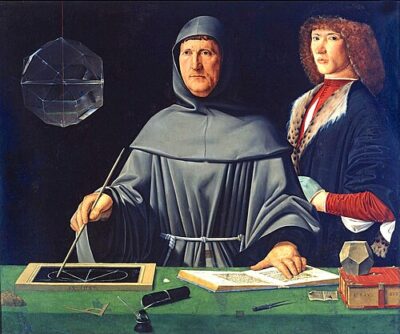
De divina proportione
De divina proportione is a book on mathematics written by Luca Pacioli and illustrated by Leonardo da Vinci. It came out in 1509.
- Published
- 1509
- Came out
- 1498
- Written by
- Luca Pacioli
- Country of origin
- Republic of Venice
All 7 facts, and where they come from
Facts
7 facts · 0 confirmed by two sources · 0 cited · 7 from one source
Where this comes from
Papalocal keeps its own record. It started from these sources; what each one said is kept here as it was copied, so a change on their side never changes this page by itself. Tap one to read its version.
What Wikidata says · copied November 17, 2026 · revision 2567731200
- Described as
- book on mathematics written by Luca Pacioli and illustrated by Leonardo da Vinci
- What it is
- written work
- Written by
- Luca Pacioli
- Publisher
- Paganino Paganini
- Published
- 1509
- Language
- Italian
- Country of origin
- Republic of Venice
- Came out
- 1498
- Wikipedias with a page
- 14
Wikidata item Q1067971 (wikidata.org/wiki/Q1067971), public domain (CC0). Copied 2026-11-17.
What Wikipedia says · copied November 17, 2026 · revision 1384304962
Divina proportione (15th century Italian for Divine proportion), later also called De divina proportione (converting the Italian title into a Latin one) is a book on mathematics written by Luca Pacioli and illustrated by Leonardo da Vinci, completed by February 9th, 1498 in Milan and first printed in 1509. Its subject was mathematical proportions (the title refers to the golden ratio) and their applications to geometry, to visual art through perspective, and to architecture. The clarity of the written material and Leonardo's excellent diagrams helped the book to achieve an impact beyond mathematical circles, popularizing contemporary geometric concepts and images.
Some of its content was plagiarised from an earlier book by Piero della Francesca, De quinque corporibus regularibus.
From the Wikipedia article “Divina proportione” (en.wikipedia.org/wiki/Divina_proportione), by its contributors, under CC BY-SA 4.0 (creativecommons.org/licenses/by-sa/4.0/). Copied 2026-11-17; not changed.
Confirmed Two sources agree. Cited One source, and it names where it got it. One source One source, without a reference of its own. Sources disagree The sources disagree. We show the best-supported value and keep theirs below.
Picture: Wikimedia Commons: De divina proportione title page.png · See Commons file page