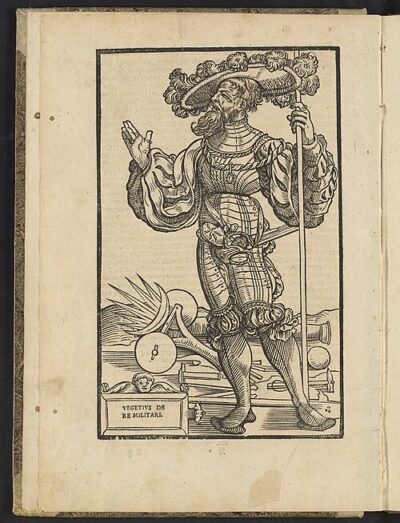
De re militari
De re militari is a 4th- or 5th-century military treatise by Vegetius.
- Came out
- 5th century
- Written by
- Vegetius
- Genre
- treatise
- Country of origin
- Western Roman Empire
All 7 facts, and where they come from
Facts
7 facts · 0 confirmed by two sources · 0 cited · 7 from one source
Where this comes from
Papalocal keeps its own record. It started from these sources; what each one said is kept here as it was copied, so a change on their side never changes this page by itself. Tap one to read its version.
What Wikidata says · copied November 17, 2026 · revision 2482210246
- Described as
- 4th- or 5th-century military treatise by Vegetius
- Other names
- Concerning Military Matters
- What it is
- treatise; written work
- Written by
- Vegetius
- Genre
- treatise
- Language
- Latin
- Country of origin
- Western Roman Empire
- Came out
- 5th century
- Wikipedias with a page
- 16
Wikidata item Q1246541 (wikidata.org/wiki/Q1246541), public domain (CC0). Copied 2026-11-17.
What Wikipedia says · copied November 17, 2026 · revision 1384747786
De re militari (Latin "Concerning Military Matters"), also Epitoma rei militaris, is a treatise by the Late Latin writer Flavius Vegetius Renatus about Roman warfare and military principles as a presentation of the methods and practices in use during the height of the Roman Empire and responsible for its power. The extant text dates to the 5th century AD.
Vegetius emphasized things such as the training of soldiers as a disciplined force, orderly strategy, maintenance of supply lines and logistics, quality leadership and use of tactics and even deceit to ensure advantage over the opposition. He was concerned about selection of good soldiers and recommended hard training of at least four months before the soldier was accepted into the ranks. The leader of the army (dux) had to take care of the men under his command and keep himself informed about the movements of the enemy to gain advantage in the battle.
De re militari became a military guide in the Middle Ages. Even after the introduction of gunpowder to Europe, the work was carried by general officers and their staffs as a field guide to methods. Friends and subordinates customarily presented embellished copies as gifts to leaders. It went on into the 18th and 19th centuries as a source of policy and strategy to the major states of Europe. In that sense, De re militari is a projection of Roman civilization into modern times and a continuation of its influence on its cultural descendants.
Vegetius appears to have lacked personal military experience, and the accuracy about the claims he makes about the Late Roman army have been questioned by modern military historians.
From the Wikipedia article “De re militari” (en.wikipedia.org/wiki/De_re_militari), by its contributors, under CC BY-SA 4.0 (creativecommons.org/licenses/by-sa/4.0/). Copied 2026-11-17; not changed.
Confirmed Two sources agree. Cited One source, and it names where it got it. One source One source, without a reference of its own. Sources disagree The sources disagree. We show the best-supported value and keep theirs below.
Picture: Wikimedia Commons: Flavius Vegetius Renatus, Epitoma de re militari, ca. 1473-1474, incipit.png · See Commons file page