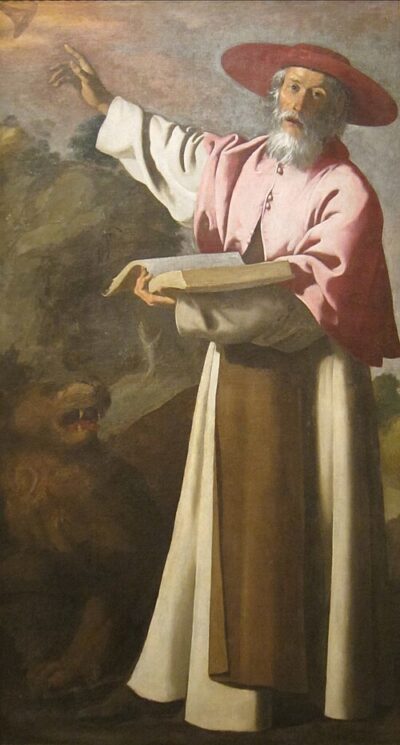
De viris illustribus
De viris illustribus is a collection of biographies by 4th-century Latin Church Father, Jerome. It came out in 392. It is based on The Twelve Caesars.
- Came out
- 392
- Written by
- Jerome
- Genre
- biography
All 9 facts, and where they come from
Facts
9 facts · 0 confirmed by two sources · 2 cited · 7 from one source
Where this comes from
Papalocal keeps its own record. It started from these sources; what each one said is kept here as it was copied, so a change on their side never changes this page by itself. Tap one to read its version.
What Wikidata says · copied November 17, 2026 · revision 2434103354
- Described as
- collection of biographies by 4th-century Latin Church Father, Jerome
- Other names
- On Illustrious Men, On famous men, De scriptoribus ecclesiasticis
- What it is
- written work; treatise
- Written by
- Jerome · 1 reference
- Genre
- biography; theological literature
- Language
- Latin · 1 reference
- Based on
- The Twelve Caesars; Autobiography
- Came out
- 392
- Wikipedias with a page
- 13
Wikidata item Q929625 (wikidata.org/wiki/Q929625), public domain (CC0). Copied 2026-11-17.
What Wikipedia says · copied November 17, 2026 · revision 1384741252
De Viris Illustribus (On Illustrious Men) is a Latin biobibliographical collection by Jerome completed at Bethlehem in 392–393 AD. It consists of a prologue and 135 chapters, each giving a brief account of an author and a list of writings, beginning with figures from the apostolic age and ending with Jerome.
Jerome presented the book as a Christian counterpart to biographical catalogues associated with Suetonius and other classical writers, and much of the early material is taken with little alteration from Eusebius of Caesarea. The work was dedicated to the Roman official Nummius Aemilianus Dexter. In the preface Jerome casts the collection as an apologetic defence of Christian learning.
The text circulated widely. It was continued by Gennadius of Massilia and later by Isidore of Seville, and the three works were often copied together. Later scholarship has criticised it as rushed and incomplete, being flattering and insulting depending on the subject and Jerome's opinion of them.
From the Wikipedia article “De Viris Illustribus (Jerome)” (en.wikipedia.org/wiki/De_Viris_Illustribus_(Jerome)), by its contributors, under CC BY-SA 4.0 (creativecommons.org/licenses/by-sa/4.0/). Copied 2026-11-17; not changed.
Confirmed Two sources agree. Cited One source, and it names where it got it. One source One source, without a reference of its own. Sources disagree The sources disagree. We show the best-supported value and keep theirs below.
Picture: Wikimedia Commons: De viris illustribus.JPEG · See Commons file page