
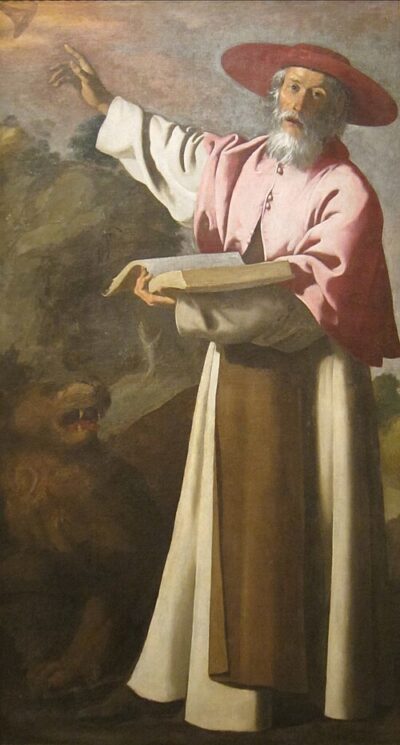
Jerome
Jerome was the 4th and 5th-century Catholic and Eastern Orthodox saint and Doctor of the Church. Born 345, in Dalmatia. Died September 30, 420, in Bethlehem. Positions held include secretary. Known for Vulgate, De viris illustribus and Chronicon.
Facts
20 facts · 0 confirmed by two sources · 5 cited · 14 from one source · 1 where the sources disagree
What’s different
- Born in: we show Dalmatia (Sources disagree). Wikidata also lists Stridon
Where this comes from
Papalocal keeps its own record. It started from these sources; what each one said is kept here as it was copied, so a change on their side never changes this page by itself. Tap one to read its version.
What Wikidata says · copied November 16, 2026 · revision 2567676211
- Described as
- 4th and 5th-century Catholic and Eastern Orthodox saint and Doctor of the Church
- Other names
- Saint Hieronymus, St. Jerome, Eusebius Hieronymus, Jerome of Stridon, Saint Jerome, Sofronius Eusebius Hieronymus, Hieronymus, Saint Heronimos, Sophronius Eusebius Hieronymus, Eusebius Sophronius Hieronymus
- Born
- 345 · 1 reference
- Died
- September 30, 420
- Born in
- Stridon; Dalmatia · 1 reference
- Died in
- Bethlehem · 1 reference
- Buried in
- Bethlehem
- Citizen of
- Ancient Rome
- Occupation
- cleric; theologian · 2 references; historian; apologist; Bible translator; anchorite; poet · 1 reference; writer · 1 reference
- Positions held
- secretary
- Known for
- Vulgate; De viris illustribus; Chronicon; Commentary on Paul's Epistle to the Galatians
- Religion
- Christianity · 1 reference
- Wikipedias with a page
- 108
Wikidata item Q44248 (wikidata.org/wiki/Q44248), public domain (CC0). Copied November 16, 2026.
What Wikipedia says · copied November 16, 2026 · revision 1385568442
Jerome of Stridon (; Latin: Eusebius Sophronius Hieronymus; Ancient Greek: Εὐσέβιος Σωφρόνιος Ἱερώνυμος; c. 342–347 – 30 September 420), also known as Hieronymus, was an early Christian priest, confessor, theologian, translator, and historian; he is commonly known as Saint Jerome.
He is best known for his translation of the Bible into Latin (the translation that became known as the Vulgate), which was commissioned by Pope Damasus I, and his commentaries on the whole Bible. Jerome attempted to create a translation of the Old Testament based on a Hebrew version, rather than the Septuagint, as prior Latin Bible translations had done. His list of writings is extensive. In addition to his biblical works, he wrote polemical and historical essays, always from a theologian's perspective.
Jerome was known for his teachings on Christian moral life, especially those in cosmopolitan centers such as Rome. He often focused on women's lives and identified how a woman devoted to Jesus should live her life. This focus stemmed from his close patron relationships with several prominent female ascetics who were members of affluent senatorial families.
Jerome is recognized as a saint and, along with Ambrose, Augustine of Hippo and Pope Gregory the Great, as one of the four Great Latin Church Fathers by the Catholic Church. He is also recognized as a saint in the Eastern Orthodox Church, the Lutheran Church, and the Anglican Communion. His feast day is 30 September (Gregorian calendar).
From the Wikipedia article “Jerome” (en.wikipedia.org/wiki/Jerome), by its contributors, under CC BY-SA 4.0 (creativecommons.org/licenses/by-sa/4.0/). Copied November 16, 2026; not changed.
Confirmed Two sources agree. Cited One source, and it names where it got it. One source One source, without a reference of its own. Sources disagree The sources disagree. We show the best-supported value and keep theirs below.
