Der Ring des Nibelungen
Der Ring des Nibelungen is a cycle of four operas by Richard Wagner. It came out in 1848. It is based on Edda.
- Came out
- 1848
- Written by
- Richard Wagner
- Created by
- Richard Wagner
- Country of origin
- German Confederation
All 11 facts, and where they come from
Facts
11 facts · 0 confirmed by two sources · 0 cited · 10 from one source · 1 where the sources disagree
What’s different
- Came out: we show 1848 (Sources disagree). Wikidata also lists 1874
Where this comes from
Papalocal keeps its own record. It started from these sources; what each one said is kept here as it was copied, so a change on their side never changes this page by itself. Tap one to read its version.
What Wikidata says · copied November 17, 2026 · revision 2557260220
- Described as
- cycle of four operas by Richard Wagner
- Other names
- The Ring of the Nibelung, Ring cycle
- What it is
- dramatico-musical work; opera cycle; tetralogy
- Written by
- Richard Wagner
- Created by
- Richard Wagner
- Music by
- Richard Wagner
- Language
- German
- Country of origin
- German Confederation
- Based on
- Edda; Völsunga saga
- Came out
- 1848; 1874
- Wikipedias with a page
- 55
Wikidata item Q190237 (wikidata.org/wiki/Q190237), public domain (CC0). Copied 2026-11-17.
What Wikipedia says · copied November 17, 2026 · revision 1377640426
Der Ring des Nibelungen (The Ring of the Nibelung), WWV 86, is a cycle of four German-language epic music dramas composed by Richard Wagner. The works are based loosely on characters from Germanic heroic legend, namely Norse legendary sagas and the Nibelungenlied. The composer termed the cycle a "Bühnenfestspiel" (stage festival play), structured in three days preceded by a Vorabend ("preliminary evening"). It is often referred to as the Ring cycle, Wagner's Ring, or simply The Ring.
Wagner wrote the libretto and music over the course of about twenty-six years, from 1848 to 1874. The four parts that constitute the Ring cycle are, in sequence:Das Rheingold (The Rhinegold)
Die Walküre (The Valkyrie)
Siegfried
Götterdämmerung (Twilight of the Gods)
Individual works of the sequence are often performed separately, and indeed the operas contain dialogues that mention events in the previous operas, so that a viewer could watch any of them without having watched the previous parts and still understand the plot. However, Wagner intended them to be performed in series. The first performance as a cycle opened the first Bayreuth Festival in 1876, beginning with Das Rheingold on 13 August and ending with Götterdämmerung on 17 August. Opera stage director Anthony Freud stated that Der Ring des Nibelungen "marks the high-water mark of our art form, the most massive challenge any opera company can undertake."
From the Wikipedia article “Der Ring des Nibelungen” (en.wikipedia.org/wiki/Der_Ring_des_Nibelungen), by its contributors, under CC BY-SA 4.0 (creativecommons.org/licenses/by-sa/4.0/). Copied 2026-11-17; not changed.
Confirmed Two sources agree. Cited One source, and it names where it got it. One source One source, without a reference of its own. Sources disagree The sources disagree. We show the best-supported value and keep theirs below.
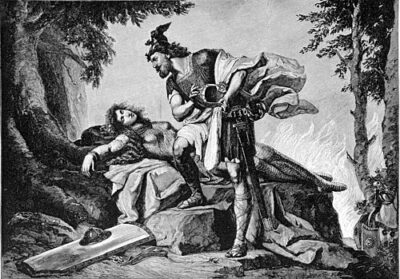
Picture: Original art by Otto Donner von Richter (1828-1911) Engraving by R. Bong (fl. 1880-1908), via Wikimedia Commons · Public domain