Deutschlandlied
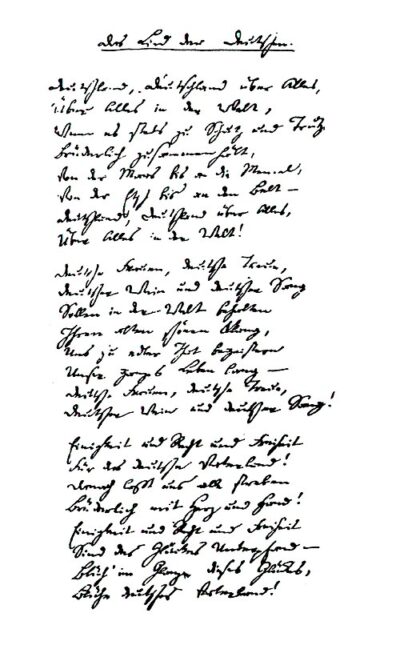
Deutschlandlied is a German patriotic song, part of which makes up the German national anthem. It came out in 1841. It was written by August Heinrich Hoffmann von Fallersleben. It is based on Gott erhalte Franz den Kaiser.
- Released
- October 5, 1841
- Came out
- August 26, 1841
- Genre
- anthem
- Country of origin
- Germany
All 12 facts, and where they come from
Facts
12 facts · 0 confirmed by two sources · 0 cited · 12 from one source
Where this comes from
Papalocal keeps its own record. It started from these sources; what each one said is kept here as it was copied, so a change on their side never changes this page by itself. Tap one to read its version.
What Wikidata says · copied November 17, 2026 · revision 2569191372
- Described as
- German patriotic song, part of which makes up the German national anthem
- Other names
- National anthem of Germany, Lied der Deutschen
- What it is
- national anthem; musical work/composition
- Written by
- August Heinrich Hoffmann von Fallersleben
- Music by
- Joseph Haydn
- Genre
- anthem
- Released
- October 5, 1841
- Language
- German
- Country of origin
- Germany · 1 reference
- Based on
- Gott erhalte Franz den Kaiser
- Came out
- August 26, 1841
- Country
- Germany; Weimar Republic
- Wikipedias with a page
- 97
Wikidata item Q44042 (wikidata.org/wiki/Q44042), public domain (CC0). Copied 2026-11-17.
What Wikipedia says · copied November 17, 2026 · revision 1386103772
The "Deutschlandlied", officially titled "Das Lied der Deutschen", is a German poem written by August Heinrich Hoffmann von Fallersleben. A popular song which was made for the cause of creating a unified German state, it was adopted in its entirety in 1922 by the Weimar Republic, replacing the de facto anthem "Heil dir im Siegerkranz". The first stanza of the "Deutschlandlied" was used alongside the "Horst-Wessel-Lied" during the Nazi regime from 1933 until the end of World War II. On the proclamation of the Federal Republic of Germany, the entirety of the song was still the official anthem, though only the 3rd verse was sung. Since the Reunification of Germany in 1991, only the third stanza was reconfirmed as the national anthem. It is discouraged, although not illegal, to perform the first and second stanza.
Its phrase "Einigkeit und Recht und Freiheit" ('unity and justice and freedom') is considered the unofficial national motto of Germany, and is inscribed on modern German Army belt buckles and the rims of some German coins.
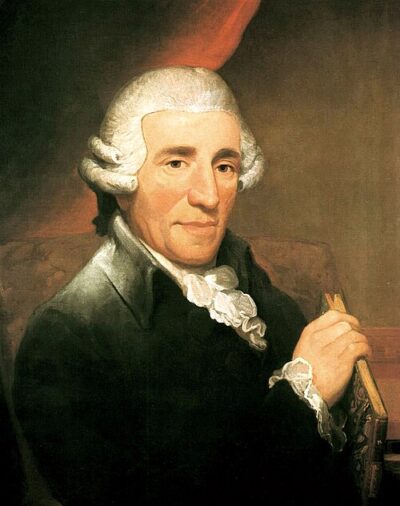
The music is derived from that of "Gott erhalte Franz den Kaiser", composed in 1797 by the Austrian composer Joseph Haydn as an anthem for the birthday of Francis II, Emperor of the Holy Roman Empire and later of Austria. In 1841, the German linguist and poet August Heinrich Hoffmann von Fallersleben wrote the lyrics of "Das Lied der Deutschen" as a new text for that music, counterposing the national unification of Germany to the eulogy of a monarch: lyrics that were considered revolutionary at the time.
From the Wikipedia article “Deutschlandlied” (en.wikipedia.org/wiki/Deutschlandlied), by its contributors, under CC BY-SA 4.0 (creativecommons.org/licenses/by-sa/4.0/). Copied 2026-11-17; not changed.
Confirmed Two sources agree. Cited One source, and it names where it got it. One source One source, without a reference of its own. Sources disagree The sources disagree. We show the best-supported value and keep theirs below.
Picture: Wikimedia Commons · Public domain