Dirac equation
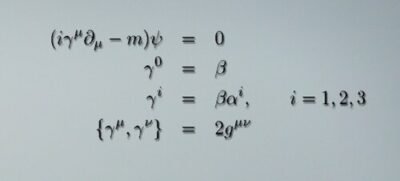
Dirac equation is a relativistic quantum mechanical wave equation.
All 2 facts, and where they come from
Facts
2 facts · 0 confirmed by two sources · 0 cited · 2 from one source
Where this comes from
Papalocal keeps its own record. It started from these sources; what each one said is kept here as it was copied, so a change on their side never changes this page by itself. Tap one to read its version.
What Wikidata says · copied November 17, 2026 · revision 2563663838
- Described as
- relativistic quantum mechanical wave equation
- What it is
- relativistic wave equation
- Named after
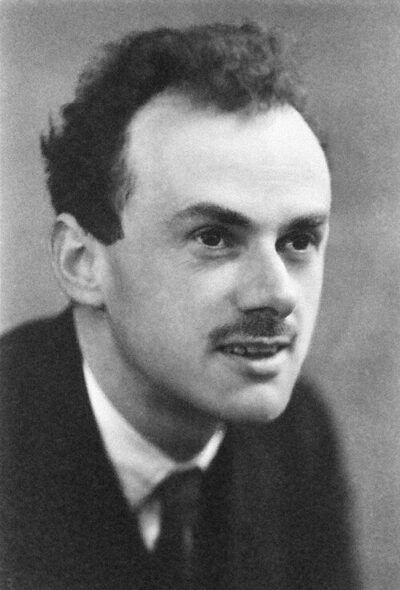
- Paul Dirac
- Wikipedias with a page
- 54
Wikidata item Q272621 (wikidata.org/wiki/Q272621), public domain (CC0). Copied 2026-11-17.
What Wikipedia says · copied November 17, 2026 · revision 1384663068
In particle physics, the Dirac equation is a relativistic wave equation derived by British physicist Paul Dirac in 1928. In its free form, or including electromagnetic interactions, it describes all spin-1/2 massive particles, called Dirac particles, or Dirac fermions such as electrons and quarks, for which parity is a symmetry. It is consistent with both quantum mechanics and special relativity, and was the first description to fully account for special relativity in the context of quantum mechanics. The equation is validated by its rigorous accounting of the observed fine structure of the hydrogen spectrum and has become vital in the building of the Standard Model.
The equation also implied the existence of a new form of matter, antimatter, previously unsuspected and unobserved.
The existence of antimatter was experimentally confirmed several years later. It also provided a theoretical justification for the introduction of several component wave functions in Pauli's phenomenological theory of spin. The wave functions in the Dirac theory are vectors of four complex numbers (known as Dirac spinors), two of which resemble the Pauli wavefunction in the non-relativistic limit, in contrast to the Schrödinger equation, which described wave functions of only one complex value. Moreover, in the limit of zero mass, the Dirac equation reduces to the Weyl equation. In the context of quantum field theory, the Dirac equation is reinterpreted to describe quantum fields corresponding to spin-1/2 particles.
Dirac did not fully appreciate the importance of his results; however, the entailed explanation of spin as a consequence of the union of quantum mechanics and relativity—and the eventual discovery of the positron—represents one of the great triumphs of theoretical physics. This accomplishment has been described as fully on par with the works of Isaac Newton, James Clerk Maxwell, and Albert Einstein before him. The equation has been deemed by some physicists to be "the real seed of modern physics". The Dirac equation has been described as the "centerpiece of relativistic quantum mechanics", and as "perhaps the most important [equation] in all of quantum mechanics".
From the Wikipedia article “Dirac equation” (en.wikipedia.org/wiki/Dirac_equation), by its contributors, under CC BY-SA 4.0 (creativecommons.org/licenses/by-sa/4.0/). Copied 2026-11-17; not changed.
Confirmed Two sources agree. Cited One source, and it names where it got it. One source One source, without a reference of its own. Sources disagree The sources disagree. We show the best-supported value and keep theirs below.
Picture: Cristóbal Alvarado Minic from Cagua, Venezuela, via Wikimedia Commons · CC BY 2.0