
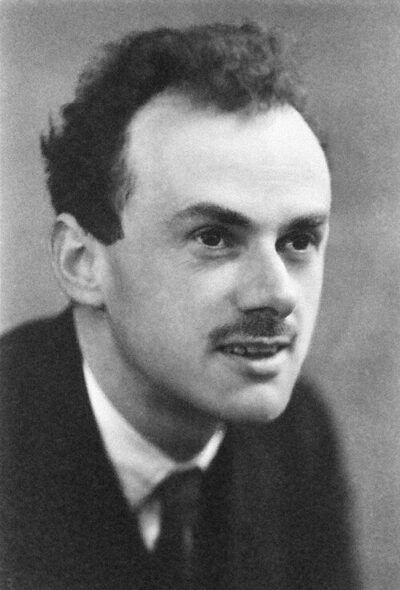
Paul Dirac
Paul Dirac was a British theoretical physicist. Born August 8, 1902, in Bristol. Died October 20, 1984, in Tallahassee. Positions held include Lucasian Professor of Mathematics (1932–1969). Known for Dirac equation, Dirac delta function and Fermi–Dirac statistics. Educated at University of Bristol and University of Cambridge. Awards include Nobel Prize in Physics, Fellow of the Royal Society and Copley Medal.
Facts
63 facts · 2 confirmed by two sources · 45 cited · 16 from one source
Where this comes from
Papalocal keeps its own record. It started from these sources; what each one said is kept here as it was copied, so a change on their side never changes this page by itself. Tap one to read its version.
What Wikidata says · copied November 16, 2026 · revision 2565693931
- Described as
- British theoretical physicist (1902–1984)
- Other names
- P A M Dirac, Paul Adrien Maurice Dirac, Paul A M Dirac, P. A. M. Dirac
- Born
- August 8, 1902 · 16 references
- Died
- October 20, 1984 · 15 references
- Born in
- Bristol · 3 references
- Died in
- Tallahassee · 3 references
- Buried in
- Roselawn Cemetery · 1 reference
- Name at birth
- Paul Adrien Maurice Dirac
- Citizen of
- United Kingdom (1919–) · 1 reference; Switzerland (–1919)
- Occupation
- mathematician · 2 references; theoretical physicist · 1 reference; professor · 1 reference; physicist · 1 reference; scientist · 1 reference; academic · 1 reference; educator · 1 reference; teacher · 1 reference
- Positions held
- Lucasian Professor of Mathematics (1932–1969) · 1 reference
- Worked for
- University of Miami (1969–1972) · 2 references; Florida State University (1969–1984) · 2 references; University of Cambridge (1932–1969) · 2 references; St John's College (1927–1932) · 1 reference
- Education
- University of Bristol (1918–1923) · 2 references; University of Cambridge (1923–1926) · 2 references; Cotham School
- Member of
- Royal Society of London (1930–) · 1 reference; German Academy of Sciences Leopoldina (1958–) · 1 reference; Pontifical Academy of Sciences (1961–) · 2 references; Academy of Sciences of the USSR (1931–) · 1 reference; American Academy of Arts and Sciences (1950–) · 1 reference; American Physical Society (1948–) · 2 references; National Academy of Sciences (1949–) · 1 reference; Academy of Sciences of Turin (1951–) · 2 references; Indian Academy of Sciences (1939–) · 1 reference; Chinese Physical Society (1943–) · 1 reference
- Known for
- Dirac equation · 1 reference; Dirac delta function; Fermi–Dirac statistics; Dirac fermion; Dirac comb; reduced Planck constant; Dirac operator; Dirac adjoint; Abraham-Lorentz-Dirac force; Dirac sea
- Awards
- Nobel Prize in Physics (1933) · 3 references; Fellow of the Royal Society (1930) · 2 references; Copley Medal (1952) · 1 reference; Royal Medal (1939) · 1 reference; Max Planck Medal (1952) · 1 reference; Helmholtz Medal (1964) · 1 reference; J. Robert Oppenheimer Memorial Prize (1969) · 1 reference; Royal Society Bakerian Medal (1941) · 1 reference; Order of Merit (1973) · 1 reference; Royal Society Bakerian Medal; doctor honoris causa from the University of Paris (1946) · 1 reference
- Field
- theoretical physics · 2 references; mathematics · 1 reference; quantum mechanics · 1 reference; quantum electrodynamics · 1 reference
- Spouse
- Margit Dirac (1937–) · 2 references
- Father
- Charles Dirac · 1 reference
- Religion
- deism · 1 reference
- Lived in
- United Kingdom · 1 reference
- Wikipedias with a page
- 125
Wikidata item Q47480 (wikidata.org/wiki/Q47480), public domain (CC0). Copied November 16, 2026.
What Wikipedia says · copied November 16, 2026 · revision 1384646995
Paul Adrien Maurice Dirac ( dih-RAK; 8 August 1902 – 20 October 1984) was an English theoretical physicist who was one of the founders of quantum mechanics. Dirac laid the foundations for quantum electrodynamics and quantum field theory. He was Lucasian Professor of Mathematics at the University of Cambridge from 1932 to 1969, and a professor of physics at Florida State University from 1970 to 1984. Dirac shared the 1933 Nobel Prize in Physics with Erwin Schrödinger "for the discovery of new productive forms of atomic theory."
Dirac graduated from the University of Bristol with a Bachelor of Science in Electrical Engineering in 1921, and a Bachelor of Arts in Mathematics in 1923. Dirac then graduated from St John's College, Cambridge, with a Doctor of Philosophy in Physics in 1926, writing the first ever thesis on quantum mechanics.
In 1928, Dirac formulated the Dirac equation, which connected special relativity and quantum mechanics, and predicted the existence of antimatter. The equation has been regarded by some physicists as "the real seed of modern physics". He contributed to Fermi–Dirac statistics, a theory which describes the behaviour of fermions, particles with half-integer spin. His 1930 monograph The Principles of Quantum Mechanics is one of the most influential texts on the subject.
Abdus Salam declared that "Dirac was undoubtedly one of the greatest physicists of this or any century ... No man except Einstein has had such a decisive influence, in so short a time, on the course of physics in this century." Stephen Hawking stated that "Dirac has done more than anyone this century, with the exception of Einstein, to advance physics and change our picture of the universe."
- Born, in its opening lines
- August 8, 1902
- Died, in its opening lines
- October 20, 1984
From the Wikipedia article “Paul Dirac” (en.wikipedia.org/wiki/Paul_Dirac), by its contributors, under CC BY-SA 4.0 (creativecommons.org/licenses/by-sa/4.0/). Copied November 16, 2026; not changed.
Confirmed Two sources agree. Cited One source, and it names where it got it. One source One source, without a reference of its own. Sources disagree The sources disagree. We show the best-supported value and keep theirs below.
