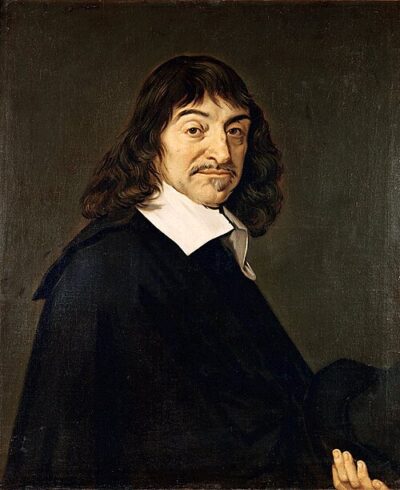
Discourse on the Method
Discourse on the Method is a work by Descartes. It came out in 1637. It was written by René Descartes.
- Published
- 1637
- Written by
- René Descartes
- Genre
- essay
All 6 facts, and where they come from
Facts
6 facts · 0 confirmed by two sources · 0 cited · 6 from one source
Where this comes from
Papalocal keeps its own record. It started from these sources; what each one said is kept here as it was copied, so a change on their side never changes this page by itself. Tap one to read its version.
What Wikidata says · copied November 17, 2026 · revision 2558909389
- Described as
- work by Descartes
- What it is
- written work
- Written by
- René Descartes
- Publisher
- Joannes Maire
- Genre
- essay
- Published
- 1637
- Language
- French
- Wikipedias with a page
- 43
Wikidata item Q731224 (wikidata.org/wiki/Q731224), public domain (CC0). Copied 2026-11-17.
What Wikipedia says · copied November 17, 2026 · revision 1384223493
Discourse on the Method of Rightly Conducting One's Reason and of Seeking Truth in the Sciences (French: Discours de la Méthode pour bien conduire sa raison, et chercher la vérité dans les sciences) is a philosophical and autobiographical treatise published by René Descartes in 1637. It is best known as the source of the famous quotation "Je pense, donc je suis" ("I think, therefore I am", or "I am thinking, therefore I exist"), which occurs in Part IV of the work. A similar argument without this precise wording is found in Meditations on First Philosophy (1641), and a Latin version of the same statement, "Cogito, ergo sum", is found in Principles of Philosophy (1644).
Discourse on the Method is one of the most influential works in the history of modern philosophy, and important to the development of natural sciences. In this work, Descartes tackles the problem of skepticism, which had previously been studied by other philosophers. While addressing some of his predecessors and contemporaries, Descartes modified their approach to account for a truth he found to be incontrovertible; he started his line of reasoning by doubting everything, so as to assess the world from a fresh perspective, clear of any preconceived notions.
The book was originally published in Leiden, in the Netherlands. Later, it was translated into Latin (Dissertatio de Methodo recte utendi ratione, et veritatem in scientiis investigandi) and published in 1656 in Amsterdam. The book was intended as an introduction to three works: La Dioptrique, Les Météores, and La Géométrie. La Géométrie contains Descartes's initial concepts that later developed into the Cartesian coordinate system. The text was written and published in French so as to reach a wider audience than Latin, the language in which most philosophical and scientific texts were written and published at that time, would have allowed. Most of Descartes's other works were written in Latin.
Together with Meditations on First Philosophy, Principles of Philosophy and Rules for the Direction of the Mind, it forms the base of the epistemology known as Cartesianism.
From the Wikipedia article “Discourse on the Method” (en.wikipedia.org/wiki/Discourse_on_the_Method), by its contributors, under CC BY-SA 4.0 (creativecommons.org/licenses/by-sa/4.0/). Copied 2026-11-17; not changed.
Confirmed Two sources agree. Cited One source, and it names where it got it. One source One source, without a reference of its own. Sources disagree The sources disagree. We show the best-supported value and keep theirs below.
Picture: Wikimedia Commons: Descartes Discours de la Methode.jpg · See Commons file page