
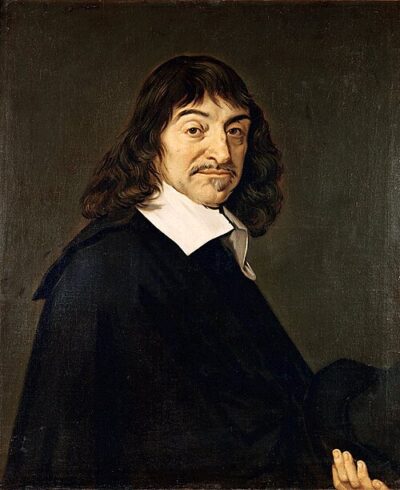
René Descartes
René Descartes was a French philosopher, mathematician, and scientist. Born March 31, 1596, in Descartes. Died February 11, 1650, in Stockholm. Positions held include professor. Known for Discourse on the Method, La Géométrie and The Description of the Human Body. Educated at collège Henri-IV de La Flèche and Leiden University.
Facts
34 facts · 2 confirmed by two sources · 13 cited · 19 from one source
Where this comes from
Papalocal keeps its own record. It started from these sources; what each one said is kept here as it was copied, so a change on their side never changes this page by itself. Tap one to read its version.
What Wikidata says · copied November 16, 2026 · revision 2567565600
- Described as
- French philosopher, mathematician, and scientist (1596–1650)
- Other names
- Renatus Cartesius, Renė Dekartas, Descartes, Cartesius
- Born
- March 31, 1596 · 20 references
- Died
- February 11, 1650 · 20 references
- Born in
- Descartes · 2 references
- Died in
- Stockholm · 4 references
- Buried in
- Royal abbey of Saint-Germain-des-Prés (1819–) · 2 references
- Cause of death
- pneumonia · 1 reference
- Citizen of
- France
- Occupation
- philosopher · 5 references; mathematician · 5 references; musicologist; physicist · 3 references; astronomer; music theorist; correspondent; mechanical automaton engineer
- Positions held
- professor
- Education
- collège Henri-IV de La Flèche · 1 reference; Leiden University; Utrecht University · 1 reference
- Member of
- French Academy of Sciences
- Known for
- Discourse on the Method; La Géométrie; The Description of the Human Body
- Field
- philosophy · 1 reference; metaphysics · 1 reference; epistemology · 1 reference; mathematics · 1 reference; mechanics · 1 reference; Cartesianism · 1 reference
- Children
- Descartés
- Father
- Joachim Descartes
- Mother
- Jeanne Brochard · 1 reference
- Siblings
- Pierre Descartes
- Religion
- Catholic Church
- Wikipedias with a page
- 256
Wikidata item Q9191 (wikidata.org/wiki/Q9191), public domain (CC0). Copied November 16, 2026.
What Wikipedia says · copied November 16, 2026 · revision 1385566007
René Descartes ( day-KART, also DAY-kart; French: [ʁəne dekaʁt] ; 31 March 1596 – 11 February 1650) was a French philosopher, mathematician, and scientist whose work was foundational to mathematics and modern philosophy, and influenced the development of early modern science. He connected the previously separate fields of geometry and algebra into analytic geometry, introduced a systematic method of inquiry that became influential in early modern philosophy, and made major contributions to epistemology and philosophy of mind as well as metaphysics.
Refusing to accept the authority of previous philosophers, Descartes frequently set his views apart from the philosophers who preceded him. In the opening section of the Passions of the Soul, an early modern treatise on emotions, Descartes goes so far as to assert that he will write on this topic "as if no one had written on these matters before". His best-known philosophical statement is "cogito, ergo sum" ("I think, therefore I am"; French: "Je pense, donc je suis").
His Meditations on First Philosophy and other philosophical works continue to be studied, and his legacy in mathematics is equally apparent. He is credited as the father of analytic geometry, which facilitated the discovery of infinitesimal calculus and analysis, and the Cartesian coordinate system is named after him.
- Born, in its opening lines
- March 31, 1596
- Died, in its opening lines
- February 11, 1650
From the Wikipedia article “René Descartes” (en.wikipedia.org/wiki/René_Descartes), by its contributors, under CC BY-SA 4.0 (creativecommons.org/licenses/by-sa/4.0/). Copied November 16, 2026; not changed.
Confirmed Two sources agree. Cited One source, and it names where it got it. One source One source, without a reference of its own. Sources disagree The sources disagree. We show the best-supported value and keep theirs below.
