discovery of nuclear fission
Discovery of nuclear fission is a 1938 achievement in physics.
All 3 facts, and where they come from
Facts
3 facts · 0 confirmed by two sources · 0 cited · 3 from one source
Where this comes from
Papalocal keeps its own record. It started from these sources; what each one said is kept here as it was copied, so a change on their side never changes this page by itself. Tap one to read its version.
What Wikidata says · copied November 16, 2026 · revision 2565259916
- Described as
- 1938 achievement in physics
- Other names
- nuclear fission discovery, discovery (nuclear fission), discovery of the nuclear fission
- What it is
- aspect of history
- Located in
- Berlin
- Country
- Germany
- Wikipedias with a page
- 12
Wikidata item Q1344449 (wikidata.org/wiki/Q1344449), public domain (CC0). Copied 2026-11-16.
What Wikipedia says · copied November 16, 2026 · revision 1381619386
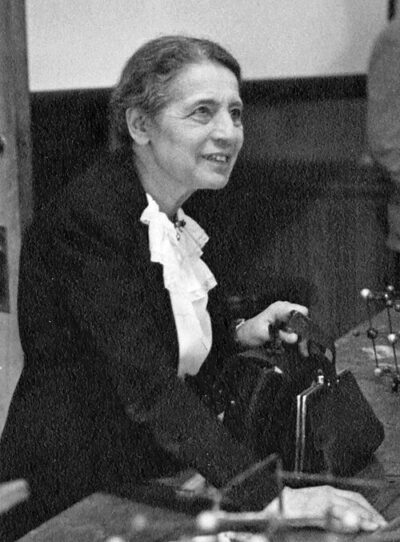
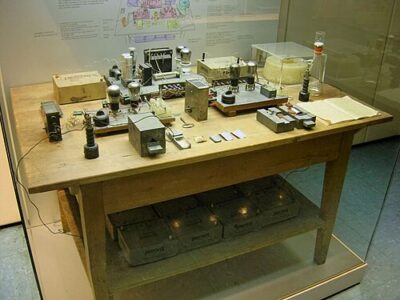
Nuclear fission was discovered in December 1938 by chemists Otto Hahn and Fritz Strassmann and physicists Lise Meitner and Otto Robert Frisch. Fission is a nuclear reaction or radioactive decay process in which the nucleus of an atom splits into two or more smaller, lighter nuclei and often other particles. The fission process often produces gamma rays and releases a very large amount of energy, even by the energetic standards of radioactive decay. Scientists already knew about alpha decay and beta decay, but fission assumed great importance because the discovery that a nuclear chain reaction was possible led to the development of nuclear power and nuclear weapons. Hahn was awarded the 1944 Nobel Prize in Chemistry for the discovery of nuclear fission.
Hahn and Strassmann at the Kaiser Wilhelm Institute for Chemistry in Berlin bombarded uranium with slow neutrons and discovered that barium had been produced. Hahn suggested a bursting of the nucleus, but he was unsure of what the physical basis for the results were. They reported their findings by mail to Meitner in Sweden, who a few months earlier had fled Nazi Germany. Meitner and her nephew Frisch theorised, and then proved, that the uranium nucleus had been split and published their findings in Nature. Meitner calculated that the energy released by each disintegration was approximately 200 megaelectronvolts, and Frisch observed this. By analogy with the division of biological cells, he named the process "fission".
The discovery came after forty years of investigation into the nature and properties of radioactivity and radioactive substances. The discovery of the neutron by James Chadwick in 1932 created a new means of nuclear transmutation. Enrico Fermi and his colleagues in Rome studied the results of bombarding uranium with neutrons, and Fermi concluded that his experiments had created new elements with 93 and 94 protons, which his group dubbed ausenium and hesperium. Fermi won the 1938 Nobel Prize in Physics for his "demonstrations of the existence of new radioactive elements produced by neutron irradiation, and for his related discovery of nuclear reactions brought about by slow neutrons". However, not everyone was convinced by Fermi's analysis of his results. Ida Noddack suggested that instead of creating a new, heavier element 93, it was conceivable that the nucleus had broken up into large fragments, and Aristid von Grosse suggested that what Fermi's group had found was an isotope of protactinium.
This spurred Hahn and Meitner, the discoverers of the most stable isotope of protactinium, to conduct a four-year-long investigation into the process with their colleague Strassmann. After much hard work and many discoveries, they determined that what they were observing was fission, and that the new elements that Fermi had found were fission products. Their work overturned long-held beliefs in physics and paved the way for the discovery of the real elements 93 (neptunium) and 94 (plutonium), for the discovery of fission in other elements, and for the determination of the role of the uranium-235 isotope in that of uranium. Niels Bohr and John Wheeler reworked the liquid drop model to explain the mechanism of fission.
From the Wikipedia article “Discovery of nuclear fission” (en.wikipedia.org/wiki/Discovery_of_nuclear_fission), by its contributors, under CC BY-SA 4.0 (creativecommons.org/licenses/by-sa/4.0/). Copied 2026-11-16; not changed.
Confirmed Two sources agree. Cited One source, and it names where it got it. One source One source, without a reference of its own. Sources disagree The sources disagree. We show the best-supported value and keep theirs below.
Picture: J Brew, via Wikimedia Commons · CC BY-SA 2.0