
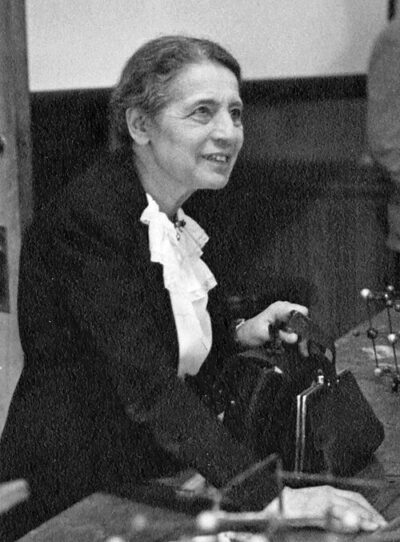
Lise Meitner
Lise Meitner was an Austrian-born physicist who became a naturalized Swedish citizen. Born in 1878, she made significant contributions to the field of nuclear physics. Her work was particularly crucial in the discovery of nuclear fission, a process that would have profound implications for science and technology. Meitner pursued a career in academia, teaching at universities and conducting research. She passed away in 1968.
Facts
50 facts · 2 confirmed by two sources · 13 cited · 35 from one source
Where this comes from
Papalocal keeps its own record. It started from these sources; what each one said is kept here as it was copied, so a change on their side never changes this page by itself. Tap one to read its version.
What Wikidata says · copied November 13, 2026 · revision 2568458234
- Described as
- Austrian-Swedish physicist
- Other names
- Elise Meitner
- Born
- November 7, 1878 · 12 references
- Died
- October 27, 1968 · 15 references
- Born in
- Vienna · 7 references
- Died in
- Cambridge · 3 references
- Buried in
- St James Churchyard · 1 reference
- Name at birth
- Elise Meitnery · 1 reference
- Citizen of
- Cisleithania (–1918); Austria (1918–1938) · 1 reference; Sweden (1949–) · 1 reference
- Occupation
- nuclear physicist · 1 reference; university teacher · 1 reference; chemist · 1 reference; physicist · 1 reference
- Positions held
- professor (1926–1938)
- Worked for
- Frederick William University Berlin; Royal Institute of Technology (1953) · 1 reference; Humboldt-Universität zu Berlin; University of Vienna · 1 reference; The Catholic University of America · 1 reference
- Education
- University of Vienna (1901–1906) · 2 references; Akademisches Gymnasium (–1901)
- Member of
- Royal Society of London (1955–) · 1 reference; German Academy of Sciences at Berlin; Royal Swedish Academy of Sciences; American Academy of Arts and Sciences; Austrian Academy of Sciences; German Academy of Sciences Leopoldina; Göttingen Academy of Sciences and Humanities in Lower Saxony
- Known for
- discovery; discovery of nuclear fission
- Awards
- Silver Leibniz medal (1924); Lieben Prize (1925); Prize of the City of Vienna for Natural Sciences (1947); Max Planck Medal (1949); Enrico Fermi Award (1966) · 1 reference; Austrian Decoration for Science and Art (1967); Pour le Mérite for Sciences and Arts order (1956); Otto Hahn Prize for Chemistry and Physics (1955); Foreign Member of the Royal Society (1955) · 1 reference; Honorary doctor of the Free University of Berlin (1957); Wilhelm Exner Medal (1960) · 1 reference; Fellow of the American Academy of Arts and Sciences
- Field
- physics · 1 reference
- Father
- Philipp Meitner · 2 references
- Mother
- Hedwig Meitner · 1 reference
- Siblings
- Auguste Frisch · 1 reference; Frida Frischauer-Meitner; Fritz Meitner
- Religion
- Judaism (1878–1908) · 1 reference; Protestant Church of the Augsburg Confession in Austria (1908–) · 1 reference
- Wikipedias with a page
- 98
Wikidata item Q56189 (wikidata.org/wiki/Q56189), public domain (CC0). Copied November 13, 2026.
What Wikipedia says · copied November 13, 2026 · revision 1383457726
Elise "Lise" Meitner ( MYTE-ner; German: [ˈliːzə ˈmaɪtnɐ] ; 7 November 1878 – 27 October 1968) was an Austrian and Swedish nuclear physicist who was instrumental in the discovery of nuclear fission.
After completing her doctoral research in 1906, Meitner became the second woman to earn a doctorate in physics from the University of Vienna. She spent much of her scientific career in Berlin, where she was a physics professor and a department head at the Kaiser Wilhelm Institute for Chemistry. She was the first woman to become a full professor of physics in Germany. She lost her positions in 1935 because of the anti-Jewish Nuremberg Laws of Nazi Germany, as well as her citizenship after the 1938 annexation of Austria by Germany. On 13–14 July 1938, she fled to the Netherlands with the help of Dirk Coster. She lived in Stockholm for many years, ultimately becoming a Swedish citizen in 1949, while insisting on keeping her Austrian citizenship, but relocated to Britain in the 1950s to be with family members.
In mid-1938, chemists Otto Hahn and Fritz Strassmann at the Kaiser Wilhelm Institute for Chemistry demonstrated that isotopes of barium could be formed by neutron bombardment of uranium. Meitner was informed of their findings by Hahn, and in late December, with her nephew, fellow physicist Otto Robert Frisch, she worked out the physics of this process by correctly interpreting Hahn and Strassmann's experimental data. On 13 January 1939, Frisch replicated the process Hahn and Strassmann had observed. In Meitner and Frisch's report in the February 1939 issue of Nature, they gave the process the name "fission". The discovery of nuclear fission led to the development of nuclear reactors and atomic bombs during World War II.
Meitner did not share the 1944 Nobel Prize in Chemistry for nuclear fission, which was awarded to her long-time collaborator Otto Hahn. Several scientists and journalists have called her exclusion "unjust". According to the Nobel Prize archive, she was nominated 19 times for the Nobel Prize in Chemistry between 1924 and 1948, and 30 times for the Nobel Prize in Physics between 1937 and 1967. Despite not having been awarded the Nobel Prize, Meitner was invited to attend the Lindau Nobel Laureate Meeting in 1962. She received many other honours, including the posthumous naming of element 109 meitnerium in 1997.
- Born, in its opening lines
- November 7, 1878
- Died, in its opening lines
- October 27, 1968
From the Wikipedia article “Lise Meitner” (en.wikipedia.org/wiki/Lise_Meitner), by its contributors, under CC BY-SA 4.0 (creativecommons.org/licenses/by-sa/4.0/). Copied November 13, 2026; not changed.
Confirmed Two sources agree. Cited One source, and it names where it got it. One source One source, without a reference of its own. Sources disagree The sources disagree. We show the best-supported value and keep theirs below.
