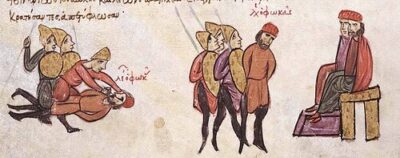
Domestic of the Schools
Domestic of the Schools is a Military post of the Byzantine Empire, extant from the 8c.
- Office of
- Byzantine Empire
All 3 facts, and where they come from
Facts
3 facts · 0 confirmed by two sources · 0 cited · 3 from one source
Where this comes from
Papalocal keeps its own record. It started from these sources; what each one said is kept here as it was copied, so a change on their side never changes this page by itself. Tap one to read its version.
What Wikidata says · copied November 18, 2026 · revision 2570349188
- Described as
- Military post of the Byzantine Empire, extant from the 8c
- What it is
- position
- Country of origin
- Byzantine Empire
- Office of
- Byzantine Empire
- Wikipedias with a page
- 16
Wikidata item Q5290188 (wikidata.org/wiki/Q5290188), public domain (CC0). Copied 2026-11-18.
What Wikipedia says · copied November 18, 2026 · revision 1356817517
The office of the Domestic of the Schools (Greek: δομέστικος τῶν σχολῶν, romanized: doméstikos tôn scholôn) was a senior military post of the Byzantine Empire, extant from the 8th century until at least the early 14th century. Originally simply the commander of the Scholai, the senior of the elite tagmata regiments, the Domestic quickly rose in prominence: by the mid-9th century, its holders essentially occupied the position of commander-in-chief of the Byzantine army, next to the Emperor. The office was eclipsed in the 12th century by that of the Grand Domestic, and in the Palaiologan period (13th–15th centuries), it was reduced to a purely honorary, mid-level court dignity.
From the Wikipedia article “Domestic of the Schools” (en.wikipedia.org/wiki/Domestic_of_the_Schools), by its contributors, under CC BY-SA 4.0 (creativecommons.org/licenses/by-sa/4.0/). Copied 2026-11-18; not changed.
Confirmed Two sources agree. Cited One source, and it names where it got it. One source One source, without a reference of its own. Sources disagree The sources disagree. We show the best-supported value and keep theirs below.