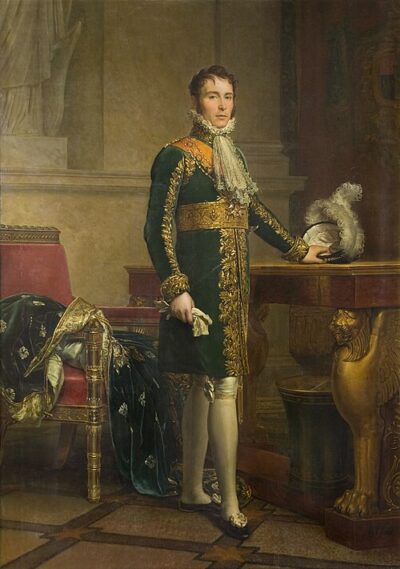
Duke of Leuchtenberg
The Duke of Leuchtenberg is a noble title. It was created in 1817.
- Created
- 1817
All 2 facts, and where they come from
Facts
2 facts · 0 confirmed by two sources · 0 cited · 2 from one source
Where this comes from
Papalocal keeps its own record. It started from these sources; what each one said is kept here as it was copied, so a change on their side never changes this page by itself. Tap one to read its version.
What Wikidata says · copied November 17, 2026 · revision 2547407492
- Described as
- noble title
- What it is
- noble title
- Created
- 1817
- Wikipedias with a page
- 14
Wikidata item Q429321 (wikidata.org/wiki/Q429321), public domain (CC0). Copied 2026-11-17.
What Wikipedia says · copied November 17, 2026 · revision 1375978181
Duke of Leuchtenberg was a title created twice by the monarchs of Bavaria for their relatives. The first creation was awarded by Maximilian I, Elector of Bavaria to his son Maximilian Philipp Hieronymus, upon whose death without children the lands passed back to his nephew Elector Maximilian II. It was re-created by Maximilian I Joseph, King of Bavaria on 14 November 1817 and awarded to his son-in-law, Eugène de Beauharnais, styled Royal Highness by personal grant, and with the style Serene Highness for his agnatic descendants. Eugène was the adopted stepson of the deposed Emperor Napoleon I of France, and had previously held the title of French prince (Prince français) with the style Imperial Highness. He also had been the emperor's heir in Frankfurt and briefly in Italy. King Maximilian Joseph compensated his son-in-law after he lost his other titles and named him heir to the kingdom after the male-line descendants of the royal house and next in precedence after the Royal Family.
The subsidiary title, also in the Bavarian peerage, was Prince of Eichstätt, but its attached territory was sold off by the 4th Duke to the King of Bavaria in 1855. On 14 July 1839, Emperor Nicholas I of Russia granted the Russian and Finnish style Imperial Highness, alongside the subsidiary title Prince Romanovsky, to the 3rd Duke, Maximilian, who had just married his daughter, Grand Duchess Maria Nikolaevna.
Nicholas Maximilianovich, 4th Duke of Leuchtenberg, was created Duke of Leuchtenberg in the Russian Empire in 1890 by Alexander III of Russia, as the ducal family was by then composed of members of the extended Russian Imperial Family. This creation once again confirmed the elevation of the style from Serene to Imperial Highness, and was to be carried by all male line descendants of Nicholas born of marriages of the corresponding rank, of the incumbent Duke from 1852 to 1891. The title was largely ceremonial, with no lands or governance attached; the style and title became "Duke von (or of) Leuchtenberg, de Beauharnais".
Following the death of the 8th Duke in 1974, no remaining heirs of full dynastic status remained; the 8th Duke's parents' marriage was the last equal marriage entered into by a male dynast of the House of Beauharnais. The title is claimed by Nicolas de Leuchtenberg (born 1933), senior heir of the 4th Duke by a morganatic marriage, whose grandfather Nicolas Nikolaievitch (1868–1928) was titled Duke of Leuchtenberg in 1890 by edict of Tsar Alexander III of Russia, with the style Highness.
From the Wikipedia article “Duke of Leuchtenberg” (en.wikipedia.org/wiki/Duke_of_Leuchtenberg), by its contributors, under CC BY-SA 4.0 (creativecommons.org/licenses/by-sa/4.0/). Copied 2026-11-17; not changed.
Confirmed Two sources agree. Cited One source, and it names where it got it. One source One source, without a reference of its own. Sources disagree The sources disagree. We show the best-supported value and keep theirs below.