
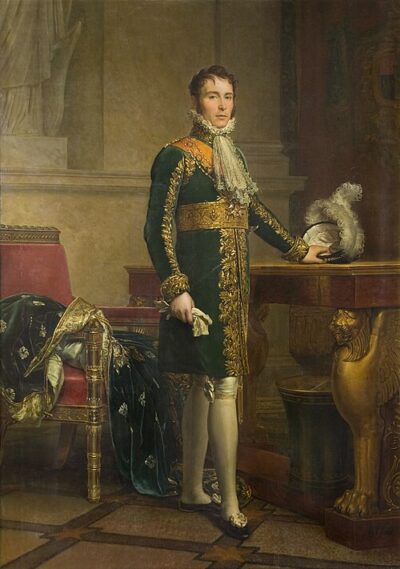
Eugène de Beauharnais
Eugène de Beauharnais was a French statesman and military officer. Born September 3, 1781, in Paris. Died February 21, 1824, in Munich. Positions held include member of the Sénat conservateur, Peer of France and Duke of Leuchtenberg. Known for Leuchtenberg Gallery. Educated at Irish College in Paris. Awards include Grand Cross of the Legion of Honour, Knight of the Order of the Golden Fleece and list of names inscribed on the Arc de Triomphe.
Facts
56 facts · 2 confirmed by two sources · 13 cited · 41 from one source
Where this comes from
Papalocal keeps its own record. It started from these sources; what each one said is kept here as it was copied, so a change on their side never changes this page by itself. Tap one to read its version.
What Wikidata says · copied November 16, 2026 · revision 2563990969
- Described as
- French statesman and military officer (1781–1824)
- Other names
- Eugene de Beauharnais, Eugen Beauharnais Leuchtenberg, Boharnais, Eugene Beauharnais, Herzog von Leuchtenberg Eugène de Beauharnais, Beauharnais, Eugène de Beauharnais, Herzog von Leuchtenberg
- Born
- September 3, 1781 · 12 references
- Died
- February 21, 1824 · 13 references
- Born in
- Paris · 3 references
- Died in
- Munich · 2 references
- Buried in
- St. Michael's Church, Munich
- Cause of death
- stroke
- Citizen of
- France · 2 references; Kingdom of Bavaria; Kingdom of Italy · 1 reference
- Occupation
- politician; military officer; military personnel · 1 reference; art collector; viceroy · 2 references
- Positions held
- member of the Sénat conservateur; Peer of France; Duke of Leuchtenberg
- Education
- Irish College in Paris
- Member of
- Bavarian Academy of Sciences and Humanities
- Known for
- Leuchtenberg Gallery
- Awards
- Grand Cross of the Legion of Honour; Knight of the Order of the Golden Fleece; list of names inscribed on the Arc de Triomphe; Order of Saint Hubert · 1 reference; Order of the Crown · 1 reference; Order of the Rue Crown · 1 reference; Royal Order of the Seraphim · 1 reference; Royal Order of the Sword · 1 reference; Order of the Iron Crown (Austria) · 1 reference; Order of Saint Stephen of Hungary · 1 reference; Commander of the Legion of Honour · 1 reference; Knight of the Legion of Honour · 1 reference
- Spouse
- Princess Augusta of Bavaria (1806–1824) · 3 references
- Children
- Amélie of Leuchtenberg; Josephine of Leuchtenberg · 1 reference; Auguste de Beauharnais · 1 reference; Maximilian de Beauharnais, 3rd Duke of Leuchtenberg; Eugénie de Beauharnais; Théodolinde de Beauharnais; Pierre Louis Marie Auguste Denis de Lagarde · 1 reference; Fanny Denis de Kereden de Tobriand · 1 reference; Carolina Clotilde de Beauharnais · 1 reference
- Father
- Alexandre de Beauharnais
- Mother
- Joséphine de Beauharnais · 1 reference
- Siblings
- Napoleon II; Stéphanie de Beauharnais; Émilie Pellapra; Hortense de Beauharnais · 1 reference; Jules Barthélemy-Saint-Hilaire; Charles Léon; Alexandre Colonna-Walewski; Eugen Megerle von Mühlfeld
- Religion
- Catholic Church
- Military branch
- cavalry; infantry
- Military rank
- general
- Wikipedias with a page
- 47
Wikidata item Q155545 (wikidata.org/wiki/Q155545), public domain (CC0). Copied November 16, 2026.
What Wikipedia says · copied November 16, 2026 · revision 1382503013
Eugène Rose de Beauharnais (French: [øʒɛn d(ə) boaʁnɛ]; 3 September 1781 – 21 February 1824) was a French statesman and military officer who served in the French Revolutionary and Napoleonic Wars. Through the second marriage of his mother, Joséphine de Beauharnais, he was the stepson of Napoleon Bonaparte. Under the French Empire, he also became Napoleon's adopted son (but not the heir to the imperial throne). Consequently, he signed his name "Eugène Napoléon". He was Viceroy of the Kingdom of Italy under his stepfather, from 1805 to 1814, and commanded the Army of Italy during the Napoleonic Wars. Historians consider him one of Napoleon's most able relatives.
- Born, in its opening lines
- September 3, 1781
- Died, in its opening lines
- February 21, 1824
From the Wikipedia article “Eugène de Beauharnais” (en.wikipedia.org/wiki/Eugène_de_Beauharnais), by its contributors, under CC BY-SA 4.0 (creativecommons.org/licenses/by-sa/4.0/). Copied November 16, 2026; not changed.
Confirmed Two sources agree. Cited One source, and it names where it got it. One source One source, without a reference of its own. Sources disagree The sources disagree. We show the best-supported value and keep theirs below.
