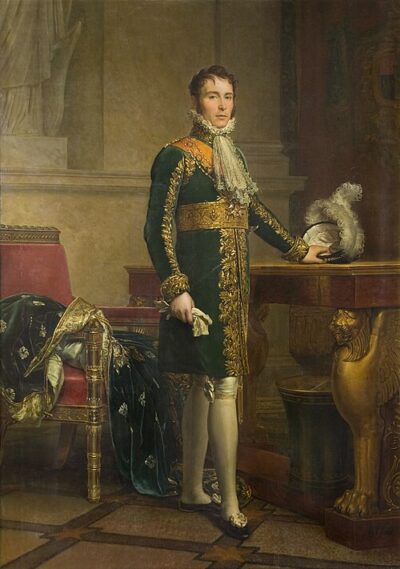
Leuchtenberg Gallery
Leuchtenberg Gallery is an art museum in Munich, Germany. It came out in 1817.
- Came out
- 1817
All 7 facts, and where they come from
Facts
7 facts · 0 confirmed by two sources · 0 cited · 7 from one source
Where this comes from
Papalocal keeps its own record. It started from these sources; what each one said is kept here as it was copied, so a change on their side never changes this page by itself. Tap one to read its version.
What Wikidata says · copied November 17, 2026 · revision 2532243374
- Described as
- art museum in Munich, Germany
- Other names
- Galerie Leuchtenberg, Duke of Leuchtenberg gallery, Leuchtenberg Gallery, Munich
- What it is
- museum
- Came out
- 1817
- Ended
- 1854
- Located in
- Munich
- Country
- Germany
- Owned by
- Eugène de Beauharnais (–1824); Maximilian de Beauharnais, 3rd Duke of Leuchtenberg (–1852)
- Wikipedias with a page
- 3
Wikidata item Q6534019 (wikidata.org/wiki/Q6534019), public domain (CC0). Copied 2026-11-17.
What Wikipedia says · copied November 17, 2026 · revision 1374149095
The Leuchtenberg Gallery was the collection of artworks of the Dukes of Leuchtenberg, on public display in Munich. The collection was widely known in 19th-century Europe, due to being open to the public and having a high-quality illustrated catalogue in different languages, and was considered one of the most important private collections of the time.
The collection was a heritage from Napoleonic times through Joséphine de Beauharnais, but with new additions by the subsequent Dukes, especially Eugène de Beauharnais. In 1810, Eugène de Beauharnais bought part of the collection of Giovanni Francesco Arese, including at least one painting by Peter Paul Rubens. By 1841, the collection was largely complete.
The Gallery was located in the Palais Leuchtenberg, the house of the Leuchtenberg family in Munich, built by Leo von Klenze between 1817 and 1821. It was opened to the public from at least 1837 on. The collection was catalogued in French and German from 1825 on, with a new version in German from 1841 on, and in an illustrated catalogue in English in 1852. After the death of Duke Maximilian in 1852, the Gallery was closed, the collection divided between his children, and the Palace sold to Luitpold, Prince Regent of Bavaria. Part of the collection was transferred to Saint Petersburg in 1854, where it was displayed in the Mariinsky Palace, and from 1870 on was lent to the Imperial Academy of Arts. The remainder moved together with Eugen Maximilianovich, Duke of Leuchtenberg, from Munich to Saint Petersburg in 1863. While the collection was still growing in the 1860s with purchases by Grand Duchess Maria Nikolaevna of Russia, by the end of the century, some works were being sold off. The majority of the collection remained together until the Russian Revolution in 1917, when it was dispersed and a number of paintings sold in Sweden. Many works were acquired by the Hermitage and the Pushkin Museum, with others ending up in museums all over the world. For example, Parmigianino's Circumcision of Jesus is now housed at the Detroit Institute of Arts. The remaining works are either lost or in private collections.
From the Wikipedia article “Leuchtenberg Gallery” (en.wikipedia.org/wiki/Leuchtenberg_Gallery), by its contributors, under CC BY-SA 4.0 (creativecommons.org/licenses/by-sa/4.0/). Copied 2026-11-17; not changed.
Confirmed Two sources agree. Cited One source, and it names where it got it. One source One source, without a reference of its own. Sources disagree The sources disagree. We show the best-supported value and keep theirs below.
Picture: Wikimedia Commons: Theodor Mattenheimer Kadettencompagnie 1852.jpg · See Commons file page