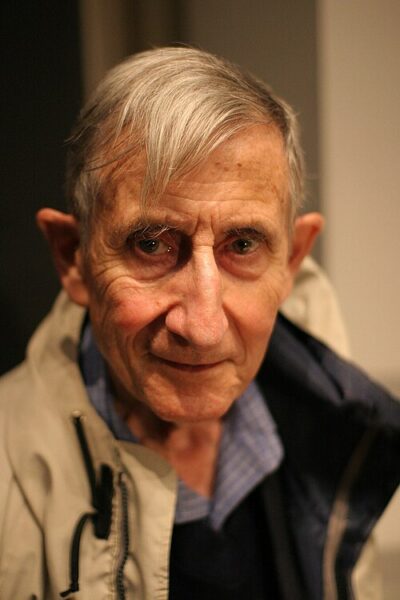
Dyson's transform
Dyson's transform is a technique in additive number theory.
All 3 facts, and where they come from
Facts
3 facts · 0 confirmed by two sources · 0 cited · 3 from one source
Where this comes from
Papalocal keeps its own record. It started from these sources; what each one said is kept here as it was copied, so a change on their side never changes this page by itself. Tap one to read its version.
What Wikidata says · copied November 16, 2026 · revision 1965585502
- Described as
- technique in additive number theory
- What it is
- method; transformation
- Named after
- Freeman Dyson
- Wikipedias with a page
- 2
Wikidata item Q5319493 (wikidata.org/wiki/Q5319493), public domain (CC0). Copied 2026-11-16.
What Wikipedia says · copied November 16, 2026 · revision 1373088465
Dyson's transform is a fundamental technique in additive number theory for transforming a pair of integer sequences into another pair of integer sequences. It was developed by Freeman Dyson as part of his proof of Mann's theorem on the Schnirelmann density of sumsets, is used to prove such fundamental results of additive number theory as the Cauchy–Davenport theorem on the size of restricted sumsets, and was used by Olivier Ramaré in his work (related to the Goldbach conjecture) that proved that every even integer is the sum of at most 6 prime numbers. The term Dyson's transform for this technique is used by Ramaré. Halberstam and Roth call it the τ-transformation.
From the Wikipedia article “Dyson's transform” (en.wikipedia.org/wiki/Dyson's_transform), by its contributors, under CC BY-SA 4.0 (creativecommons.org/licenses/by-sa/4.0/). Copied 2026-11-16; not changed.
Confirmed Two sources agree. Cited One source, and it names where it got it. One source One source, without a reference of its own. Sources disagree The sources disagree. We show the best-supported value and keep theirs below.