
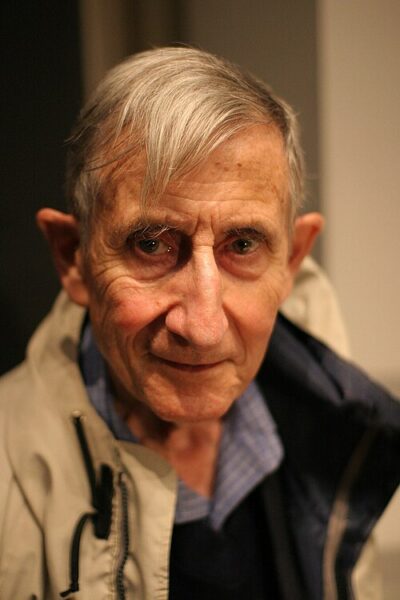
Freeman Dyson
Freeman Dyson was a theoretical physicist and mathematician. Born December 15, 1923, in Crowthorne. Died February 28, 2020, in Princeton. Positions held include professor. Known for Dyson sphere, Disturbing the Universe and Infinite in All Directions. Educated at University of Cambridge and Winchester College (2 times). Awards include Templeton Prize, Henri Poincaré Prize and Oersted Medal.
Facts
68 facts · 2 confirmed by two sources · 34 cited · 32 from one source
Where this comes from
Papalocal keeps its own record. It started from these sources; what each one said is kept here as it was copied, so a change on their side never changes this page by itself. Tap one to read its version.
What Wikidata says · copied November 13, 2026 · revision 2562971045
- Described as
- theoretical physicist and mathematician (1923–2020)
- Other names
- Freeman J. Dyson, Freeman John Dyson
- Born
- December 15, 1923 · 4 references
- Died
- February 28, 2020 · 2 references
- Born in
- Crowthorne · 1 reference
- Died in
- Princeton · 2 references
- Cause of death
- falling from height · 1 reference
- Name at birth
- Freeman John Dyson · 1 reference
- Citizen of
- United Kingdom; United States (1957–)
- Occupation
- mathematician · 2 references; theoretical physicist; nuclear physicist; statistician; physicist · 2 references; university teacher · 1 reference
- Positions held
- professor
- Worked for
- University of Birmingham (1949–1951) · 1 reference; Institute for Advanced Study (1953–2020) · 1 reference; Cornell University (1951–1953) · 2 references; Imperial College London (1945–1946) · 1 reference
- Education
- University of Cambridge (–1946) · 1 reference; Winchester College (2 times) (1928–1941) · 1 reference; Trinity College (1941–1945) · 1 reference; Twyford School (1932–1936) · 1 reference
- Member of
- Royal Society of London (1952–); French Academy of Sciences (1989–); Accademia Nazionale dei Lincei (2010–) · 1 reference; National Academy of Sciences (1964–); Bavarian Academy of Sciences and Humanities; American Academy of Arts and Sciences; Russian Academy of Sciences (2011–); American Philosophical Society · 1 reference; American Physical Society · 1 reference; International Astronomical Union
- Known for
- Dyson sphere · 1 reference; Disturbing the Universe · 1 reference; Infinite in All Directions · 1 reference; Dyson conjecture; Dyson tree; Dyson's eternal intelligence; Dyson's transform; Dyson series; Dyson equation; Crank conjecture
- Awards
- Templeton Prize (2000) · 1 reference; Henri Poincaré Prize (2012) · 1 reference; Oersted Medal (1991) · 2 references; Enrico Fermi Award (1993) · 1 reference; Lorentz Medal (1966) · 1 reference; Harvey Prize (1977) · 1 reference; Hughes Medal (1968) · 1 reference; Max Planck Medal (1969) · 1 reference; Wolf Prize in Physics (1981) · 2 references; Josiah Willard Gibbs Lectureship (1972) · 1 reference; Matteucci Medal (1989) · 1 reference; J. Robert Oppenheimer Memorial Prize (1970) · 1 reference; Dannie Heineman Prize for Mathematical Physics (1965) · 1 reference; Pomeranchuk Prize (2003) · 1 reference; honorary doctor of Yeshiva University
- Field
- mathematical physics; solid-state physics · 1 reference; mathematics · 1 reference
- Spouse
- Verena Huber-Dyson (1950–1958) · 1 reference
- Children
- Esther Dyson; George Dyson
- Father
- George Dyson · 1 reference
- Mother
- Mildred Atkey · 1 reference
- Lived in
- United States · 1 reference
- Website
- https://www.ias.edu/sns/dyson
- Wikipedias with a page
- 75
Wikidata item Q153717 (wikidata.org/wiki/Q153717), public domain (CC0). Copied November 13, 2026.
What Wikipedia says · copied November 13, 2026 · revision 1384755416
Freeman John Dyson (15 December 1923 – 28 February 2020) was a British-American theoretical physicist and mathematician who worked in quantum field theory, astrophysics, random matrices, mathematical formulation of quantum mechanics, condensed matter physics, nuclear physics, and engineering. He was professor emeritus in the Institute for Advanced Study in Princeton and a member of the board of sponsors of the Bulletin of the Atomic Scientists.
Dyson originated several concepts that bear his name, such as Dyson's transform, a fundamental technique in additive number theory, which he developed as part of his proof of Mann's theorem; the Dyson tree, a hypothetical genetically engineered plant capable of growing in a comet; the Dyson series, a perturbative series where each term is represented by Feynman diagrams; the Dyson sphere, a thought experiment that attempts to explain how a space-faring civilization would meet its energy requirements with a hypothetical megastructure that completely encompasses a star and captures a large percentage of its power output; and Dyson's eternal intelligence, a means by which an immortal society of intelligent beings in an open universe could escape the prospect of the heat death of the universe by extending subjective time to infinity while expending only a finite amount of energy. Drawing on Niels Bohr's principle of complementarity, he argued that science and spirituality were compatible. Dyson was a regular contributor to The New York Review of Books and published a memoir, Disturbing the Universe (1979). This was bookended by Maker of Patterns: An Autobiography Through Letters (2018).
He disagreed with the scientific consensus on climate change. He believed that some of the effects of increased CO2 levels are favourable and not taken into account by climate scientists, such as increased agricultural yield, and further that the positive benefits of CO2 likely outweigh the negative effects. He was skeptical about the simulation models used to predict climate change, arguing that political efforts to reduce causes of climate change distract from other global problems that should take priority. He was awarded the 1996 Lewis Thomas Prize and the 2000 Templeton Prize. He wrote, "As we look out into the Universe and identify the many accidents of physics and astronomy that have worked together to our benefit, it almost seems as if the Universe must in some sense have known that we were coming."
- Born, in its opening lines
- December 15, 1923
- Died, in its opening lines
- February 28, 2020
From the Wikipedia article “Freeman Dyson” (en.wikipedia.org/wiki/Freeman_Dyson), by its contributors, under CC BY-SA 4.0 (creativecommons.org/licenses/by-sa/4.0/). Copied November 13, 2026; not changed.
Confirmed Two sources agree. Cited One source, and it names where it got it. One source One source, without a reference of its own. Sources disagree The sources disagree. We show the best-supported value and keep theirs below.
