Economic and Philosophic Manuscripts of 1844
Economic and Philosophic Manuscripts of 1844 is an essay by Karl Marx. It came out in 1932.
- Published
- 1932
- Written by
- Karl Marx
- Genre
- philosophical non-fiction literature
All 6 facts, and where they come from
Facts
6 facts · 0 confirmed by two sources · 0 cited · 6 from one source
Where this comes from
Papalocal keeps its own record. It started from these sources; what each one said is kept here as it was copied, so a change on their side never changes this page by itself. Tap one to read its version.
What Wikidata says · copied November 17, 2026 · revision 2558499800
- Described as
- essay by Karl Marx
- Other names
- The Economic-Philosophical Manuscripts, The Paris Manuscripts, Paris Manuscripts, Economic and philosophic manuscripts, Economic and Philosophical Manuscripts of 1844
- What it is
- written work
- Written by
- Karl Marx
- Genre
- philosophical non-fiction literature; essay · 1 reference
- Published
- 1932
- Language
- German · 1 reference
- Wikipedias with a page
- 28
Wikidata item Q295347 (wikidata.org/wiki/Q295347), public domain (CC0). Copied 2026-11-17.
What Wikipedia says · copied November 17, 2026 · revision 1384800413
The Economic and Philosophic Manuscripts of 1844 (German: Ökonomisch-philosophische Manuskripte aus dem Jahre 1844), also known as the Paris Manuscripts (Pariser Manuskripte) or as the 1844 Manuscripts, are a series of unfinished notes written between April and August 1844 by Karl Marx. They were compiled and published posthumously in 1932 by the Soviet Union's Marx–Engels–Lenin Institute. They were first published in their original German in Berlin, and there followed a republication in the Soviet Union in 1933, also in German.
The Manuscripts provide a critique of classical political economy grounded in the philosophies of Georg Wilhelm Friedrich Hegel and Ludwig Feuerbach. The work is best known for its articulation of Marx's argument that the conditions of modern industrial societies result in the estrangement (or alienation) of wage-workers from their own products, from their own work, and in turn from themselves and from each other. Marx argues that workers are forced by the capitalist productive process to work solely to satisfy their basic needs. As such, they merely exist as commodities in a constant state of drudgery, evaluated solely by their monetary value, with capital assuming the status of a good in and of itself.
The publication of the Manuscripts greatly altered the reception of Marx by situating his work within a theoretical framework that had until then been unavailable to his followers. While the text's importance was often downplayed by orthodox Marxists as being "philosophical" or "anthropological" rather than "scientific", the notebooks provide insight into Marx's thought at the time of its first formulation.
From the Wikipedia article “Economic and Philosophic Manuscripts of 1844” (en.wikipedia.org/wiki/Economic_and_Philosophic_Manuscripts_of_1844), by its contributors, under CC BY-SA 4.0 (creativecommons.org/licenses/by-sa/4.0/). Copied 2026-11-17; not changed.
Confirmed Two sources agree. Cited One source, and it names where it got it. One source One source, without a reference of its own. Sources disagree The sources disagree. We show the best-supported value and keep theirs below.
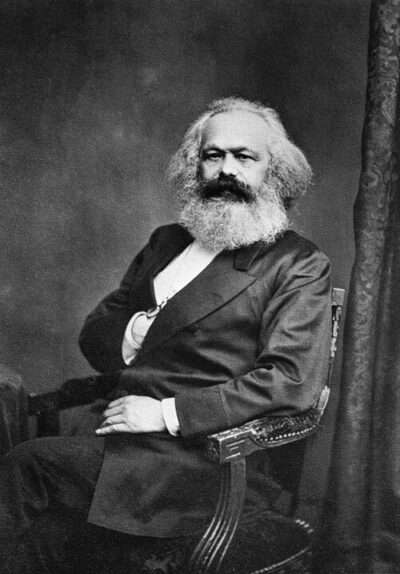
Picture: Karl Marx, via Wikimedia Commons · Public domain