Edward II
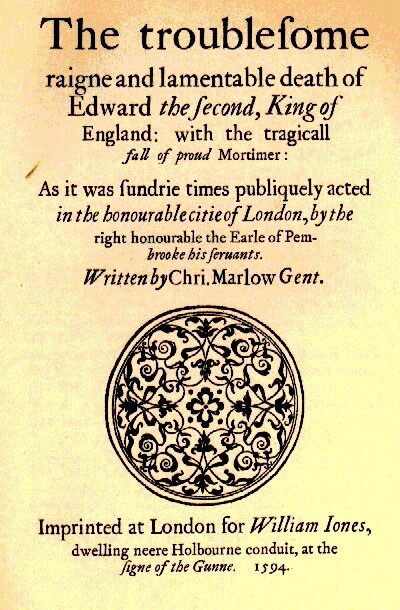
Edward II is a play by Christopher Marlowe. It came out in 1594.
- Published
- 1594
- Written by
- Christopher Marlowe
- Genre
- tragedy
All 5 facts, and where they come from
Facts
5 facts · 0 confirmed by two sources · 0 cited · 5 from one source
Where this comes from
Papalocal keeps its own record. It started from these sources; what each one said is kept here as it was copied, so a change on their side never changes this page by itself. Tap one to read its version.
What Wikidata says · copied November 17, 2026 · revision 2567026383
- Described as
- play by Christopher Marlowe
- Other names
- The Troublesome Reign and Lamentable Death of Edward the Second, King of England, with the Tragical Fall of Proud Mortimer
- What it is
- literary work
- Written by
- Christopher Marlowe
- Genre
- tragedy
- Published
- 1594
- Language
- English
- Wikipedias with a page
- 15
Wikidata item Q195219 (wikidata.org/wiki/Q195219), public domain (CC0). Copied 2026-11-17.
What Wikipedia says · copied November 17, 2026 · revision 1369540298
The Troublesome Reign and Lamentable Death of Edward the Second, King of England, with the Tragical Fall of Proud Mortimer, known as Edward II, is a Renaissance or early modern period play written by the English playwright Christopher Marlowe. It is one of the earliest English history plays, and focuses on the relationship between King Edward II of England and Piers Gaveston, and Edward's murder on the orders of Roger Mortimer.
Marlowe found most of his material for this play in the third volume of Raphael Holinshed's Chronicles (1587). Frederick S. Boas believes that "out of all the rich material provided by Holinshed" Marlowe was drawn to "the comparatively unattractive reign of Edward II" due to the relationship between the King and Gaveston. Boas elaborates, "Homosexual affection ... has (as has been seen) a special attraction for Marlowe. Jove and Ganymede in Dido, Henry III and his 'minions' in The Massacre, Neptune and Leander in Hero and Leander, and all akin, although drawn to a slighter scale, to Edward and Gaveston." Boas also notes the existence of a number of parallels between Edward II and The Massacre at Paris, asserting that "it is scarcely too much to say that scenes xi–xxi of The Massacre are something in the nature of a preliminary sketch for Edward II." Marlowe stayed close to the account but embellished it with the character of Lightborn (or Lucifer) as Edward's assassin.
From the Wikipedia article “Edward II (play)” (en.wikipedia.org/wiki/Edward_II_(play)), by its contributors, under CC BY-SA 4.0 (creativecommons.org/licenses/by-sa/4.0/). Copied 2026-11-17; not changed.
Confirmed Two sources agree. Cited One source, and it names where it got it. One source One source, without a reference of its own. Sources disagree The sources disagree. We show the best-supported value and keep theirs below.
Picture: Wikimedia Commons · Public domain