Elective Affinities
Elective Affinities is a novel by Johann Wolfgang von Goethe. It came out in 1809.
- Published
- 1809
- Came out
- 1809
- Written by
- Johann Wolfgang von Goethe
- Country of origin
- Germany
All 7 facts, and where they come from
Facts
7 facts · 0 confirmed by two sources · 0 cited · 7 from one source
Where this comes from
Papalocal keeps its own record. It started from these sources; what each one said is kept here as it was copied, so a change on their side never changes this page by itself. Tap one to read its version.
What Wikidata says · copied November 17, 2026 · revision 2559584019
- Described as
- novel by Johann Wolfgang von Goethe
- What it is
- literary work
- Written by
- Johann Wolfgang von Goethe
- Published
- 1809
- Language
- German
- Country of origin
- Germany
- Comes after
- Wilhelm Meister's Apprenticeship
- Came out
- 1809
- Wikipedias with a page
- 21
Wikidata item Q951198 (wikidata.org/wiki/Q951198), public domain (CC0). Copied 2026-11-17.
What Wikipedia says · copied November 17, 2026 · revision 1385792468
Elective Affinities (German: Die Wahlverwandtschaften), also translated under the title Kindred by Choice, is the third novel by Johann Wolfgang von Goethe, published in 1809. Situated around the city of Weimar, the book relates the story of Eduard and Charlotte, an aristocratic couple enjoying an idyllic but somewhat mundane life on a secluded estate; although it is the second marriage for both, their relationship deteriorates after they invite Eduard's friend Captain Otto and Charlotte's orphaned niece, Ottilie, to live with them in their mansion. The invitation to Ottilie and the Captain is described as an "experiment", as it indeed is. The house and its surrounding gardens are described as "a chemical retort in which the human elements are brought together for the reader to observe the resulting reaction." As if in a chemical reaction, each of the spouses experiences a strong new attraction, which is reciprocated: Charlotte, who represents reason, to the sensible and energetic Captain Otto; the impulsive and passionate Eduard to the adolescent and charming Ottilie. The conflict between passion and reason leads to chaos and ultimately to a tragic end.
The novel combines elements of Weimar Classicism, such as the plot layout as a scientific parable, with an opposing tendency towards Romanticism. The term “elective affinities” was originally a scientific term from chemistry, once widely used by scientists such as Robert Boyle, Isaac Newton and Antoine Lavoisier, at first to describe exothermic chemical reactions and later to refer to chemical reactions in which one ion would displace another. Goethe applied this understanding from physical chemistry as a metaphor for human passions supposedly being governed or regulated by such laws of chemical affinity, and examined whether the laws of chemistry somehow undermine or uphold the institution of marriage, as well as other human social relations. Voluntary renunciation also comes into play, a theme that recurs in his fourth novel, Wilhelm Meisters Wanderjahre, oder Die Entsagenden (Wilhelm Meister's Journeyman Years, or the Renunciants).
From the Wikipedia article “Elective Affinities” (en.wikipedia.org/wiki/Elective_Affinities), by its contributors, under CC BY-SA 4.0 (creativecommons.org/licenses/by-sa/4.0/). Copied 2026-11-17; not changed.
Confirmed Two sources agree. Cited One source, and it names where it got it. One source One source, without a reference of its own. Sources disagree The sources disagree. We show the best-supported value and keep theirs below.
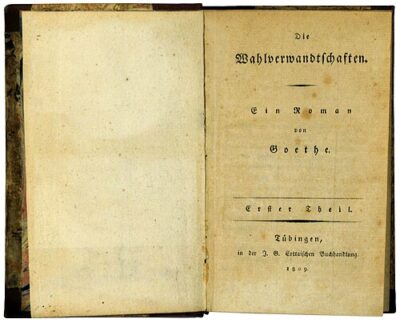
Picture: © Foto H.-P.Haack. Objektfotografie, Bearbeitung (= eigenes Werk). Das Foto darf gebührenfrei verwendet werden, sofern der Urheber mit „Wikipedia: Foto H.-P.Haack“ angegeben wird., via Wikimedia Commons · CC BY-SA 3.0