
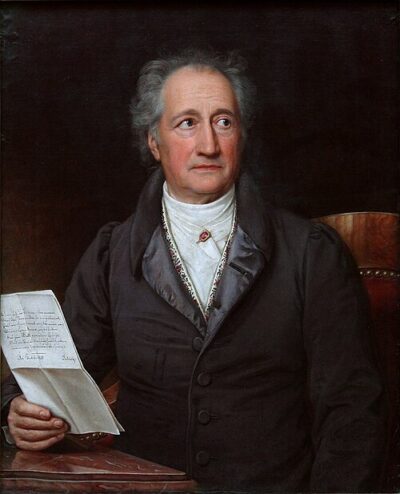
Johann Wolfgang von Goethe
Johann Wolfgang von Goethe was a German writer, artist, natural scientist and politician. Born August 28, 1749, in Frankfurt. Died March 22, 1832, in Weimar. Positions held include Geheimrat. Known for Faust, The Sorrows of Young Werther and Wilhelm Meister's Apprenticeship. Educated at Leipzig University and University of Strasbourg. Awards include Merit Order of the Bavarian Crown, Officer of the Legion of Honour and Order of Saint Anna, 1st class.
Facts
58 facts · 2 confirmed by two sources · 11 cited · 45 from one source
Where this comes from
Papalocal keeps its own record. It started from these sources; what each one said is kept here as it was copied, so a change on their side never changes this page by itself. Tap one to read its version.
What Wikidata says · copied November 16, 2026 · revision 2565594678
- Described as
- German writer, artist, natural scientist and politician (1749–1832)
- Other names
- Johann Wolfgang von Göthe, Johann Wolfgang Von Goethe, Göthe, Goethe, Johann Wolfgang Göthe, Johann Wolfgang Goethe
- Born
- August 28, 1749 · 25 references
- Died
- March 22, 1832 · 14 references
- Born in
- Frankfurt · 6 references
- Died in
- Weimar · 5 references
- Buried in
- Weimarer Fürstengruft · 1 reference
- Cause of death
- myocardial infarction · 1 reference
- Name at birth
- Johann Wolfgang Goethe · 1 reference
- Citizen of
- Duchy of Saxe-Weimar-Eisenach (1775–)
- Occupation
- theatre manager; botanist; politician · 2 references; philosopher · 1 reference; theologian; jurist · 2 references; art critic; music critic
- Positions held
- Geheimrat
- Education
- Leipzig University (1765–1768); University of Strasbourg (1770–1771)
- Member of
- German Academy of Sciences Leopoldina; Academy of Science for Public Utility; Bavarian Academy of Sciences and Humanities; Göttingen Academy of Sciences and Humanities in Lower Saxony; Royal Prussian Academy of Sciences; German Archaeological Institute; Freemasonry; Zentral-Dombauverein zu Köln von 1842; Silesian Society for the Culture of the Fatherland (1822–); Warsaw Society of Friends of Learning
- Genre
- lyric poetry · 1 reference; drama · 1 reference; tragedy · 1 reference
- Known for
- Faust; The Sorrows of Young Werther; Wilhelm Meister's Apprenticeship; Elective Affinities; Prometheus; Theory of Colours; Italian Journey; West–Eastern Diwan; Egmont; Der Zauberlehrling
- Awards
- Merit Order of the Bavarian Crown (1827); Officer of the Legion of Honour (1808) · 1 reference; Order of Saint Anna, 1st class (1808); Grand Cross of the House Order of the White Falcon (1816); Knight Commander of the Order of Leopold (Austria); Grand Cross of the Legion of Honour · 1 reference
- Field
- anatomy; meteorology; geology; physics
- Spouse
- Christiane Vulpius · 1 reference
- Children
- August von Goethe · 1 reference
- Father
- Johann Caspar Goethe · 1 reference
- Mother
- Catharina Elisabeth Goethe · 1 reference
- Siblings
- Cornelia Schlosser · 1 reference
- Religion
- Lutheranism
- Wikipedias with a page
- 280
Wikidata item Q5879 (wikidata.org/wiki/Q5879), public domain (CC0). Copied November 16, 2026.
What Wikipedia says · copied November 16, 2026 · revision 1385817437
Johann Wolfgang von Goethe (28 August 1749 – 22 March 1832) was a German polymath who is widely regarded as the most influential writer in the German language. His work has had a wide-ranging influence on literary, political, Christian views, and philosophical thought in the Western world from the late 18th century to the present. A poet, playwright, novelist, scientist, statesman, theatre-director, and critic, Goethe wrote a wide range of works, including plays, poetry and aesthetic criticism, as well as treatises on botany, anatomy, and colour.
Goethe took up residence in Weimar in 1775 following the success of his first novel, The Sorrows of Young Werther (1774), and joined a thriving intellectual and cultural environment under the patronage of Duchess Anna Amalia that formed the basis of Weimar Classicism. He was ennobled by Karl August, Duke of Saxe-Weimar, in 1782. Goethe was an early participant in the Sturm und Drang literary movement. During his first ten years in Weimar, Goethe became a member of the Duke's privy council (1776–1785), sat on the war and highway commissions, oversaw the reopening of silver mines in nearby Ilmenau, and implemented a series of administrative reforms at the University of Jena. He also contributed to the planning of Weimar's botanical park and the rebuilding of its Ducal Palace.
Goethe's first major scientific work, the Metamorphosis of Plants, was published after he returned from a 1788 tour of Italy. In 1791 he was made managing director of the theatre at Weimar, and in 1794 he began a friendship with the dramatist, historian, and philosopher Friedrich Schiller, whose plays he premiered until Schiller's death in 1805. During this period, Goethe published his second novel, Wilhelm Meister's Apprenticeship; the verse epic Hermann and Dorothea, and, in 1808, the first part of his most celebrated drama, Faust. His conversations and various shared undertakings throughout the 1790s with Schiller, Johann Gottlieb Fichte, Johann Gottfried Herder, Alexander von Humboldt, Wilhelm von Humboldt, and August and Friedrich Schlegel have come to be collectively termed Weimar Classicism.
The German philosopher Arthur Schopenhauer named Wilhelm Meister's Apprenticeship one of the four greatest novels ever written, while the American philosopher and essayist Ralph Waldo Emerson selected Goethe as one of six "representative men" in his work of the same name (along with Plato, Emanuel Swedenborg, Michel de Montaigne, Napoleon, and William Shakespeare). Goethe's comments and observations form the basis of several biographical works, notably Johann Peter Eckermann's Conversations with Goethe (1836). His poems were set to music by many composers, including Wolfgang Amadeus Mozart, Ludwig van Beethoven, Franz Schubert, Hector Berlioz, Franz Liszt, Richard Wagner, and Gustav Mahler.
- Born, in its opening lines
- August 28, 1749
- Died, in its opening lines
- March 22, 1832
From the Wikipedia article “Johann Wolfgang von Goethe” (en.wikipedia.org/wiki/Johann_Wolfgang_von_Goethe), by its contributors, under CC BY-SA 4.0 (creativecommons.org/licenses/by-sa/4.0/). Copied November 16, 2026; not changed.
Confirmed Two sources agree. Cited One source, and it names where it got it. One source One source, without a reference of its own. Sources disagree The sources disagree. We show the best-supported value and keep theirs below.
