Prometheus
Prometheus is a poem by Johann Wolfgang von Goethe, written 1773, published 1785.
- Published
- 1785
- Came out
- 1774
- Written by
- Johann Wolfgang von Goethe
All 7 facts, and where they come from
Facts
7 facts · 0 confirmed by two sources · 0 cited · 7 from one source
Where this comes from
Papalocal keeps its own record. It started from these sources; what each one said is kept here as it was copied, so a change on their side never changes this page by itself. Tap one to read its version.
What Wikidata says · copied November 17, 2026 · revision 2555877081
- Described as
- poem by Johann Wolfgang von Goethe, written 1773, published 1785
- What it is
- literary work
- Written by
- Johann Wolfgang von Goethe
- Published
- 1785
- Language
- German
- Based on
- Prometheus
- Came out
- 1774
- Named after
- Prometheus
- Wikipedias with a page
- 19
Wikidata item Q2112787 (wikidata.org/wiki/Q2112787), public domain (CC0). Copied 2026-11-17.
What Wikipedia says · copied November 17, 2026 · revision 1316375615
"Prometheus" is a poem by Johann Wolfgang von Goethe, in which the character of the mythic Prometheus addresses God (as Zeus) in misotheist accusation and defiance. The poem was written between 1772 and 1774 and first published in 1789. Friedrich Heinrich Jacobi published an anonymous and unauthorised version in 1785. It is an important work of the German Sturm und Drang movement.
In early editions of the Collected Works of Goethe, it appeared in Volume II of his poems in a section of Vermischte Gedichte (assorted poems), shortly following the "Gesang der Geister über den Wassern", and the Harzreise im Winter. It is immediately followed by "Ganymed", and the two poems together should be understood as a pair. Both belong to the period 1770 to 1775.
Prometheus (1774) was planned as a drama but not completed; this poem draws upon that original vision. Prometheus is the creative and rebellious spirit which, rejected by God, angrily defies him and asserts itself; Ganymede is the boyish self that is adored and seduced by God. One is the lone defiant, the other the yielding acolyte. As the humanist poet, Goethe presents both identities as aspects or forms of the human condition.
Although the setting is classical, the address to the Biblical God is suggested by the section beginning "Da ich ein Kind war..." ("When I was a child"): the use of Da is distinctive, and by it Goethe evokes the Lutheran translation of Saint Paul's First Epistle to the Corinthians, 13:11: "Da ich ein Kind war, da redete ich wie ein Kind..." ("When I was a child, I spoke as a child, I understood as a child, I thought as a child: but when I became a man, I put away childish things"). Unlike Paul, Goethe's Prometheus grew up to reject belief in the divine heart moved to pity for the afflicted. Prometheus's reference to making man in his image draws strongly on Luther's translation of the words of God in Genesis 1:26 ("Laßt uns Menschen machen, ein Bild, das uns gleich sei").
The poem was set to music by J. F. Reichardt, Franz Schubert (see "Prometheus", 1819); Hugo Wolf (1889), and F.M. Einheit (1993).
From the Wikipedia article “Prometheus (Goethe)” (en.wikipedia.org/wiki/Prometheus_(Goethe)), by its contributors, under CC BY-SA 4.0 (creativecommons.org/licenses/by-sa/4.0/). Copied 2026-11-17; not changed.
Confirmed Two sources agree. Cited One source, and it names where it got it. One source One source, without a reference of its own. Sources disagree The sources disagree. We show the best-supported value and keep theirs below.
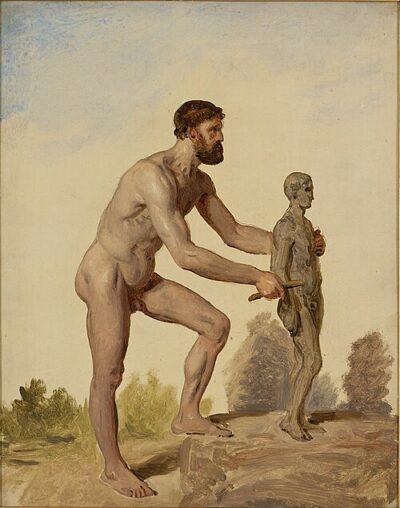
Picture: Constantin Hansen, via Wikimedia Commons · Public domain