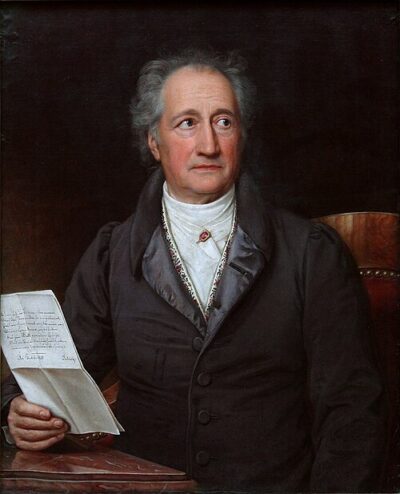
Theory of Colours
Theory of Colours is a 1810 book by Johann Wolfgang von Goethe.
- Published
- 1810
- Written by
- Johann Wolfgang von Goethe
All 5 facts, and where they come from
Facts
5 facts · 0 confirmed by two sources · 4 cited · 1 from one source
Where this comes from
Papalocal keeps its own record. It started from these sources; what each one said is kept here as it was copied, so a change on their side never changes this page by itself. Tap one to read its version.
What Wikidata says · copied November 17, 2026 · revision 2564366939
- Described as
- 1810 book by Johann Wolfgang von Goethe
- What it is
- written work
- Written by
- Johann Wolfgang von Goethe · 1 reference
- Publisher
- Cotta'sche Verlagsbuchhandlung · 1 reference
- Published
- 1810 · 1 reference
- Language
- German · 1 reference
- Wikipedias with a page
- 26
Wikidata item Q112667736 (wikidata.org/wiki/Q112667736), public domain (CC0). Copied 2026-11-17.
What Wikipedia says · copied November 17, 2026 · revision 1384800420
Theory of Colours (German: Zur Farbenlehre, lit. 'On color theory') is a book by Johann Wolfgang von Goethe about the poet's views on the nature of colours and how they are perceived by humans. It was published in German in 1810 and in English in 1840. The book contains detailed descriptions of phenomena such as coloured shadows, refraction, and chromatic aberration. The book is a successor to two short essays titled "Contributions to Optics" (German: Beiträge zur Optik).
The work originated in Goethe's occupation with painting and primarily had its influence in the arts, with painters such as (Philipp Otto Runge, J. M. W. Turner, the Pre-Raphaelites, Hilma af Klint, and Wassily Kandinsky).
Although Goethe's work was rejected by some physicists, a number of philosophers and physicists have concerned themselves with it, including Thomas Johann Seebeck, Arthur Schopenhauer (see: On Vision and Colors), Hermann von Helmholtz, Ludwig Wittgenstein, Werner Heisenberg, Kurt Gödel, and Mitchell Feigenbaum.
Goethe's book provides a catalogue of how colour is perceived in a wide variety of circumstances, and considers Isaac Newton's observations to be special cases. Unlike Newton, Goethe's concern was not so much with the analytic treatment of colour, as with the qualities of how phenomena are perceived. Philosophers have come to understand the distinction between the optical spectrum, as observed by Newton, and the phenomenon of human colour perception as presented by Goethe—a subject analyzed at length by Ludwig Wittgenstein in his comments on Goethe's theory in Remarks on Colour and in Jonathan Westphal's Commentary on this work (1991).
From the Wikipedia article “Theory of Colours” (en.wikipedia.org/wiki/Theory_of_Colours), by its contributors, under CC BY-SA 4.0 (creativecommons.org/licenses/by-sa/4.0/). Copied 2026-11-17; not changed.
Confirmed Two sources agree. Cited One source, and it names where it got it. One source One source, without a reference of its own. Sources disagree The sources disagree. We show the best-supported value and keep theirs below.
Picture: Wikimedia Commons: Goethe, Farbenkreis zur Symbolisierung des menschlichen Geistes- und Seelenlebens, 1809.jpg · See Commons file page