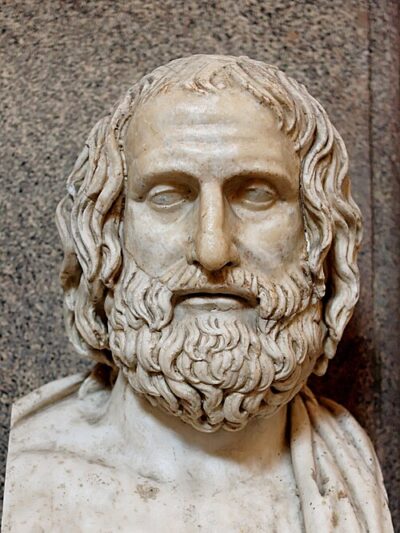
Electra
Electra is an ancient Greek tragedy by Euripides. It came out in -413.
- Came out
- 413 BC
- Written by
- Euripides
- Genre
- Greek tragedy
All 5 facts, and where they come from
Facts
5 facts · 0 confirmed by two sources · 3 cited · 2 from one source
Where this comes from
Papalocal keeps its own record. It started from these sources; what each one said is kept here as it was copied, so a change on their side never changes this page by itself. Tap one to read its version.
What Wikidata says · copied November 17, 2026 · revision 2565893250
- Described as
- ancient Greek tragedy by Euripides
- Other names
- Eur. El.
- What it is
- dramatic work
- Written by
- Euripides · 1 reference
- Genre
- Greek tragedy · 1 reference
- Language
- Ancient Greek · 1 reference
- Came out
- 413 BC
- Wikipedias with a page
- 33
Wikidata item Q540161 (wikidata.org/wiki/Q540161), public domain (CC0). Copied 2026-11-17.
What Wikipedia says · copied November 17, 2026 · revision 1370741623
Euripides' Electra (Ancient Greek: Ἠλέκτρα, Ēlektra) is a tragedy probably written in the mid 410s BC, likely before 413 BC. A version of the myth of the house of Atreus, Euripides' play reworks important aspects of the story found in Aeschylus' Oresteia trilogy (especially the second play, Libation Bearers) and also in Sophocles' Electra, although the relative dating of Euripides' and Sophocles' plays remain uncertain. In his tragedy, Euripides introduces startling and disturbing elements that ask his audience (and readers) to question the nature of tragic 'heroism,' assumptions of appropriate gender behavior, and the morality of both human characters and the gods.
From the Wikipedia article “Electra (Euripides play)” (en.wikipedia.org/wiki/Electra_(Euripides_play)), by its contributors, under CC BY-SA 4.0 (creativecommons.org/licenses/by-sa/4.0/). Copied 2026-11-17; not changed.
Confirmed Two sources agree. Cited One source, and it names where it got it. One source One source, without a reference of its own. Sources disagree The sources disagree. We show the best-supported value and keep theirs below.