
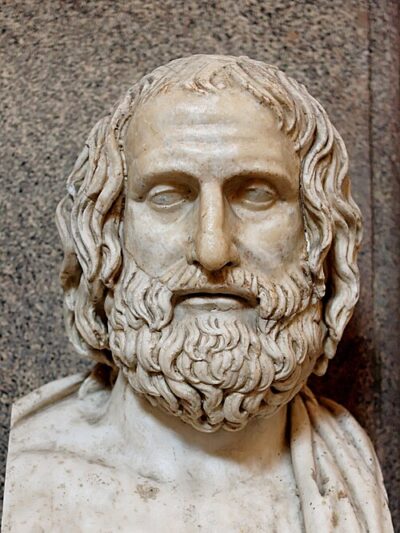
Euripides
Euripides was a Classical Athenian playwright. Born 480s BC, in Salamis Island. Died 400s BC, in Pella. Known for Alcestis, Andromache and The Bacchae.
Facts
28 facts · 0 confirmed by two sources · 12 cited · 16 from one source
Where this comes from
Papalocal keeps its own record. It started from these sources; what each one said is kept here as it was copied, so a change on their side never changes this page by itself. Tap one to read its version.
What Wikidata says · copied November 16, 2026 · revision 2567497339
- Described as
- Classical Athenian playwright
- Born
- 480s BC
- Died
- 400s BC
- Born in
- Salamis Island · 7 references
- Died in
- Pella · 3 references
- Buried in
- Cenotaph of Euripides, Athens
- Citizen of
- Classical Athens
- Occupation
- tragedy writer · 1 reference; playwright · 2 references; writer · 1 reference; poet · 1 reference; philosopher · 1 reference
- Genre
- Greek tragedy
- Known for
- Alcestis; Andromache; The Bacchae; Hecuba; Helen; Electra; Herakles' Children; Herakles; The Suppliants; Hippolytus
- Field
- drama · 1 reference; poetry · 1 reference; philosophy · 1 reference
- Children
- Euripides the Younger · 1 reference
- Father
- Mnesarchus · 1 reference
- Mother
- Cleito · 1 reference
- Wikipedias with a page
- 158
Wikidata item Q48305 (wikidata.org/wiki/Q48305), public domain (CC0). Copied November 16, 2026.
What Wikipedia says · copied November 16, 2026 · revision 1384040526
Euripides (; Ancient Greek: Eὐριπίδης, romanized: Eurīpídēs, pronounced [eu̯.riː.pí.dɛːs]; c. 480 – c. 406 BC) was a Greek tragedian of classical Athens. Along with Aeschylus and Sophocles, he is one of the three authors of Greek tragedy whose name is ascribed to surviving plays. Some ancient scholars attributed ninety-five plays to him, but the Suda says it was ninety-two at most. Nineteen plays attributed to Euripides have survived more or less complete, although one of these (Rhesus) is often considered not to be genuinely his work. Many fragments (some of them substantial) survive from most of his other plays. More of his plays have survived intact than those of Aeschylus and Sophocles together, partly because his popularity grew as theirs declined: he became, in the Hellenistic Age, a cornerstone of ancient literary education, along with Homer, Demosthenes, and Menander.
Euripides is identified with theatrical innovations that have profoundly influenced drama down to modern times, especially in the representation of traditional, mythical heroes as ordinary people in extraordinary circumstances. This new approach led him to pioneer developments that later writers adapted to comedy, some of which are characteristic of romance. He was referred to by Aristotle as "the most tragic of poets", probably in reference to a perceived preference for unhappy endings, but Aristotle's remark is seen by Bernard Knox as having wider relevance, since "in his representation of human suffering Euripides pushes to the limits of what an audience can stand; some of his scenes are almost unbearable." Focusing on the inner lives and motives of his characters in a way previously unknown, Euripides was "the creator of ... that cage which is the theatre of Shakespeare’s Othello, Racine’s Phèdre, of Ibsen and Strindberg," in which "imprisoned men and women destroy each other by the intensity of their loves and hates". But he was also the literary ancestor of comic dramatists as diverse as Menander and George Bernard Shaw.
In the comedies of his contemporary Aristophanes, Euripides is lampooned for his intellectualism. Modern scholars have varied greatly in their views of Euripides, with some regarding him as an iconoclastic intellectual, and others seeing him as a more traditional playwright. Euripides's portrayal of women has attracted particular interest in modern times, on account of the perceptiveness and sympathy with which Euripides depicts women and the difficulties facing them in Greek society, especially in his Medea.
From the Wikipedia article “Euripides” (en.wikipedia.org/wiki/Euripides), by its contributors, under CC BY-SA 4.0 (creativecommons.org/licenses/by-sa/4.0/). Copied November 16, 2026; not changed.
Confirmed Two sources agree. Cited One source, and it names where it got it. One source One source, without a reference of its own. Sources disagree The sources disagree. We show the best-supported value and keep theirs below.
