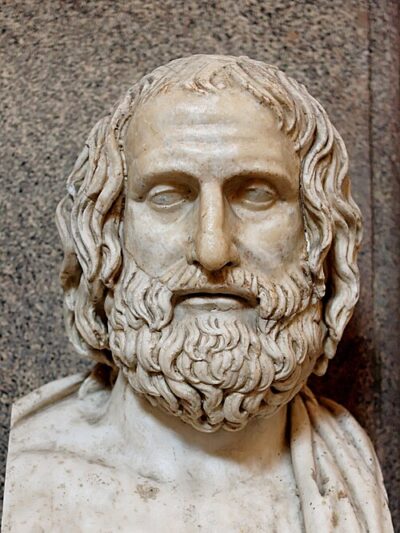
Hecuba
Hecuba is an ancient Greek tragedy by Euripides. It came out in -424.
- Came out
- 424 BC
- Written by
- Euripides
- Genre
- Greek tragedy
All 5 facts, and where they come from
Facts
5 facts · 0 confirmed by two sources · 3 cited · 2 from one source
Where this comes from
Papalocal keeps its own record. It started from these sources; what each one said is kept here as it was copied, so a change on their side never changes this page by itself. Tap one to read its version.
What Wikidata says · copied November 17, 2026 · revision 2555904862
- Described as
- ancient Greek tragedy by Euripides
- Other names
- Eur. Hec.
- What it is
- dramatic work
- Written by
- Euripides · 1 reference
- Genre
- Greek tragedy · 1 reference
- Language
- Ancient Greek · 1 reference
- Came out
- 424 BC
- Wikipedias with a page
- 25
Wikidata item Q1115611 (wikidata.org/wiki/Q1115611), public domain (CC0). Copied 2026-11-17.
What Wikipedia says · copied November 17, 2026 · revision 1373938735
Hecuba (Ancient Greek: Ἑκάβη, Hekabē) is a tragedy by Euripides, written c. 424 BC. It takes place after the Trojan War but before the Greeks have departed Troy (roughly the same time as The Trojan Women, another play by Euripides). The central figure is Hecuba, wife of King Priam, formerly queen of the now-fallen city. It depicts Hecuba's grief over the death of her daughter Polyxena and the revenge she takes for the murder of her youngest son, Polydorus.
From the Wikipedia article “Hecuba (play)” (en.wikipedia.org/wiki/Hecuba_(play)), by its contributors, under CC BY-SA 4.0 (creativecommons.org/licenses/by-sa/4.0/). Copied 2026-11-17; not changed.
Confirmed Two sources agree. Cited One source, and it names where it got it. One source One source, without a reference of its own. Sources disagree The sources disagree. We show the best-supported value and keep theirs below.
Picture: Wikimedia Commons: Euripides, Hekabe, with a latin translation and marginalia by Leontius Pilatus, Florence, San Marco 226, fol. 1r.jpg · See Commons file page