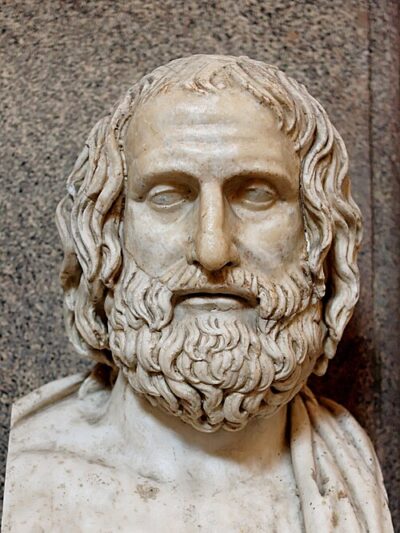
The Bacchae
The Bacchae is an ancient Greek tragedy by Euripides.
- Written by
- Euripides
- Genre
- Greek tragedy
All 4 facts, and where they come from
Facts
4 facts · 0 confirmed by two sources · 3 cited · 1 from one source
Where this comes from
Papalocal keeps its own record. It started from these sources; what each one said is kept here as it was copied, so a change on their side never changes this page by itself. Tap one to read its version.
What Wikidata says · copied November 17, 2026 · revision 2565895078
- Described as
- ancient Greek tragedy by Euripides
- Other names
- The Bacchantes, The Bacchæ, The Bacchanals, Bacchae, Bacchanals, Eur. Ba., Bakkhai
- What it is
- dramatic work
- Written by
- Euripides · 1 reference
- Genre
- Greek tragedy · 1 reference
- Language
- Ancient Greek · 1 reference
- Wikipedias with a page
- 42
Wikidata item Q934597 (wikidata.org/wiki/Q934597), public domain (CC0). Copied 2026-11-17.
What Wikipedia says · copied November 17, 2026 · revision 1379632260
The Bacchae (; Ancient Greek: Βάκχαι, Bakkhai; also known as The Bacchantes ) is an ancient Greek tragedy, written by the Athenian playwright Euripides during his final years in Macedonia, at the court of Archelaus I of Macedon. It premiered posthumously at the Theatre of Dionysus in 405 BC as part of a tetralogy that also included Iphigeneia at Aulis and Alcmaeon in Corinth, and which Euripides' son or nephew is assumed to have directed. It won first prize in the City Dionysia festival competition.
The tragedy recounts the Greek myth of King Pentheus of Thebes and his mother Agave, who were punished by the god Dionysus (who is Pentheus's cousin) for rejecting his cult. The play opens with Dionysus proclaiming that he has arrived in Thebes with his votaries to avenge the slander, repeated by his aunts, that he is not the son of Zeus. Disguised as a foreign holy man, the god intends to introduce Dionysian rites into the city, but the Thebans reject his divinity and king Pentheus orders his arrest.
Eventually, Dionysus drives Pentheus insane, luring him to the mountains. The play ends with the women of Thebes, driven by Dionysus's orgiastic frenzy, tearing Pentheus apart, while his mother Agave bears his head on a thyrsus to her father Cadmus.
Regarded as Euripides' masterpiece, The Bacchae is classified among the greatest ancient tragedies. The Bacchae is distinctive in that the chorus is integrated into the plot and the god is not a distant presence, but a character in the play, indeed, the protagonist.
From the Wikipedia article “The Bacchae” (en.wikipedia.org/wiki/The_Bacchae), by its contributors, under CC BY-SA 4.0 (creativecommons.org/licenses/by-sa/4.0/). Copied 2026-11-17; not changed.
Confirmed Two sources agree. Cited One source, and it names where it got it. One source One source, without a reference of its own. Sources disagree The sources disagree. We show the best-supported value and keep theirs below.
Picture: Wikimedia Commons: Pompeii - Casa dei Vettii - Pentheus.jpg · See Commons file page