
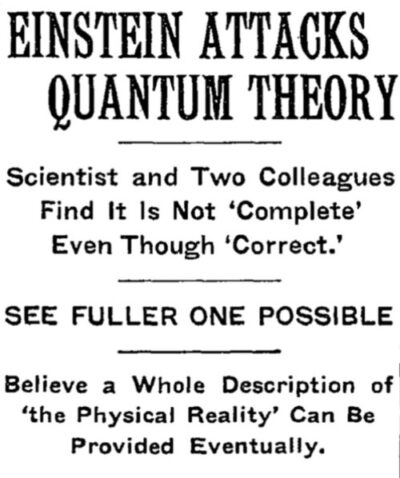
EPR paradox
EPR paradox is an early and influential critique leveled against quantum mechanics. It came out in 1935.
- Released
- 1935
All 4 facts, and where they come from
Facts
4 facts · 0 confirmed by two sources · 0 cited · 4 from one source
Where this comes from
Papalocal keeps its own record. It started from these sources; what each one said is kept here as it was copied, so a change on their side never changes this page by itself. Tap one to read its version.
What Wikidata says · copied November 17, 2026 · revision 2565444660
- Described as
- early and influential critique leveled against quantum mechanics
- Other names
- Einstein–Podolsky–Rosen paradox
- What it is
- thought experiment
- Released
- 1935
- Named after
- Albert Einstein; Boris Podolsky
- Wikipedias with a page
- 46
Wikidata item Q214975 (wikidata.org/wiki/Q214975), public domain (CC0). Copied 2026-11-17.
What Wikipedia says · copied November 17, 2026 · revision 1374716936
The Einstein–Podolsky–Rosen (EPR) paradox is a thought experiment proposed by physicists Albert Einstein, Boris Podolsky and Nathan Rosen, which argues that the description of physical reality provided by quantum mechanics is incomplete. In a 1935 paper titled "Can Quantum-Mechanical Description of Physical Reality be Considered Complete?", they argued for the existence of "elements of reality" that were not part of quantum theory, and speculated that it should be possible to construct a theory containing these hidden variables. Resolutions of the paradox have important implications for the interpretation of quantum mechanics.
The thought experiment involves a pair of particles prepared in what would later become known as an entangled state. Einstein, Podolsky, and Rosen pointed out that, in this state, if the position of the first particle were measured, the result of measuring the position of the second particle could be predicted. If instead the momentum of the first particle were measured, then the result of measuring the momentum of the second particle could be predicted. They argued that no action taken on the first particle could instantaneously affect the other, since this would involve information being transmitted faster than light, which is impossible according to the theory of relativity. They invoked a principle, later known as the "EPR criterion of reality", which posited that: "If, without in any way disturbing a system, we can predict with certainty (i.e., with probability equal to unity) the value of a physical quantity, then there exists an element of reality corresponding to that quantity." From this, they inferred that the second particle must have a definite value of both position and of momentum prior to either quantity being measured. But quantum mechanics considers these two observables incompatible and thus does not associate simultaneous values for both to any system. Einstein, Podolsky, and Rosen therefore concluded that quantum theory does not provide a complete description of reality.
From the Wikipedia article “Einstein–Podolsky–Rosen paradox” (en.wikipedia.org/wiki/Einstein–Podolsky–Rosen_paradox), by its contributors, under CC BY-SA 4.0 (creativecommons.org/licenses/by-sa/4.0/). Copied 2026-11-17; not changed.
Confirmed Two sources agree. Cited One source, and it names where it got it. One source One source, without a reference of its own. Sources disagree The sources disagree. We show the best-supported value and keep theirs below.
Picture: New York Times, via Wikimedia Commons · Public domain
