
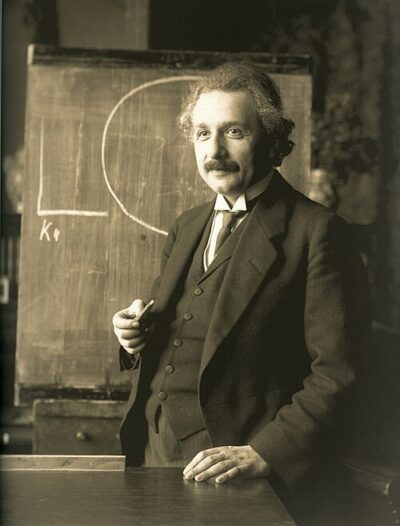
Albert Einstein
Albert Einstein was a German-born theoretical physicist. Born March 14, 1879, in Ulm. Died April 18, 1955, in Princeton. Positions held include professor (1911–). Known for special relativity, general relativity and photoelectric effect. Educated at ETH Zurich and Luitpold-Gymnasium. Awards include Barnard Medal for Meritorious Service to Science, Nobel Prize in Physics and Gold Medal of the Royal Astronomical Society.
Facts
85 facts · 2 confirmed by two sources · 36 cited · 46 from one source · 1 where the sources disagree
What’s different
- Buried in: we show National Museum of Health and Medicine (Sources disagree). Wikidata also lists Delaware River
Where this comes from
Papalocal keeps its own record. It started from these sources; what each one said is kept here as it was copied, so a change on their side never changes this page by itself. Tap one to read its version.
What Wikidata says · copied November 13, 2026 · revision 2568772868
- Described as
- German-born theoretical physicist (1879–1955)
- Other names
- A. Einstein, Einstein
- Born
- March 14, 1879 · 26 references
- Died
- April 18, 1955 · 26 references
- Born in
- Ulm · 7 references
- Died in
- Princeton · 5 references
- Buried in
- National Museum of Health and Medicine; Delaware River
- Cause of death
- abdominal aortic aneurysm
- Citizen of
- Kingdom of Württemberg (–1896) · 2 references; statelessness (1896–1901) · 1 reference; Switzerland (1901–) · 1 reference; Cisleithania (1911–1912) · 1 reference
- Occupation
- theoretical physicist; philosopher of science; inventor; science writer; pedagogue; university teacher (1909–) · 1 reference; physicist · 7 references; philosopher · 3 references
- Positions held
- professor (1911–)
- Political party
- German Democratic Party (–1933)
- Worked for
- Swiss Federal Institute of Intellectual Property (1902–1909) · 1 reference; Charles University; University of Zurich (1909–1911) · 1 reference; German University in Prague (1911–1912); ETH Zurich (1912–1914); Kaiser Wilhelm Society (1917–1933); Princeton University (1933–1955) · 1 reference; Leiden University (1920–1946)
- Education
- ETH Zurich (1896–1900) · 2 references; Luitpold-Gymnasium (1888–1894); Old Kantonsschule (Albert Einstein House) (1895–1896); University of Zurich (–1905) · 1 reference
- Member of
- Royal Society of London (1921–) · 1 reference; Royal Prussian Academy of Sciences; German Academy of Sciences Leopoldina (1932–); American Philosophical Society (1930–); Bavarian Academy of Sciences and Humanities (1927–1933) · 1 reference; Göttingen Academy of Sciences and Humanities in Lower Saxony (1923–1933) · 1 reference; French Academy of Sciences (1933–) · 1 reference; Royal Swedish Academy of Sciences; Royal Netherlands Academy of Arts and Sciences (1920–) · 1 reference; American Academy of Arts and Sciences (1924–) · 1 reference
- Instrument
- violin
- Known for
- special relativity; general relativity; photoelectric effect; theory of relativity; theory of Brownian Motion; mass–energy equivalence; Planck constant; Einstein field equations; quantum mechanics; unified field theory
- Awards
- Barnard Medal for Meritorious Service to Science (1920); Nobel Prize in Physics (1921) · 2 references; Gold Medal of the Royal Astronomical Society (1926) · 1 reference; Prix Jules Janssen (1931) · 1 reference; Matteucci Medal (1921) · 1 reference; Max Planck Medal (1929) · 1 reference; Franklin Medal (1935) · 1 reference; Copley Medal (1925) · 1 reference; Pour le Mérite for Sciences and Arts order (1923); Josiah Willard Gibbs Lectureship (1934); Honorary doctorate from the University of Geneva; honorary doctor of the Hebrew University of Jerusalem (1949) · 1 reference; honorary doctorate from Princeton University; honorary doctor of the University of Madrid Complutense (1923); Foreign Member of the Royal Society (1921) · 1 reference
- Field
- theoretical physics
- Spouse
- Mileva Marić (1903–1919) · 1 reference; Elsa Einstein (1919–1936) · 1 reference
- Children
- Hans Albert Einstein · 1 reference; Eduard Einstein · 1 reference; Lieserl (Einstein)
- Father
- Hermann Einstein · 1 reference
- Mother
- Pauline Koch
- Siblings
- Maja Einstein
- Religion
- agnosticism · 1 reference; Judaism (1879–1891) · 1 reference
- Lived in
- Einsteinhaus Caputh (1929–1932); Einsteinhaus (1903–1905); Munich; Princeton; Smíchov (1911–) · 1 reference
- Website
- https://alberteinstein.com · 1 reference
- Wikipedias with a page
- 323
Wikidata item Q937 (wikidata.org/wiki/Q937), public domain (CC0). Copied November 13, 2026.
What Wikipedia says · copied November 13, 2026 · revision 1384665341
Albert Einstein (14 March 1879 – 18 April 1955) was a German-born theoretical physicist best known for developing the theory of relativity. Einstein also made important contributions to quantum theory. His mass–energy equivalence formula E = mc2, which arises from special relativity, has been called "the world's most famous equation". He received the 1921 Nobel Prize in Physics for "his services to theoretical physics, and especially for his discovery of the law of the photoelectric effect".
Born as a subject to the Kingdom of Württemberg, part of the German Empire, which he later renounced on 28 January 1896, just 6 weeks before he turned 17, avoiding conscription into military service. The familiy moved to Munich in 1880, where he grew up and attended primary, lower and higher secondary schools. In 1895, he moved to Pavia, Italy, to stay with his family which moved there an year earlier and then further to Swiss canton of Aargau to attend a final year in gymnasium in Aarau. In 1896, at the age of seventeen, he enrolled in the mathematics and physics teaching diploma program at the Swiss federal polytechnic school in Zurich, graduating in 1900. He acquired Swiss citizenship a year later, which he kept for the rest of his life, and afterwards secured a permanent position at the Swiss Patent Office in Bern. In 1905, he submitted a successful PhD dissertation to the University of Zurich. In 1914, he moved to Berlin to join the Prussian Academy of Sciences and the Humboldt University of Berlin, becoming director of the Kaiser Wilhelm Institute for Physics in 1917; he also became a Prussian and consequently also German citizen again. In 1933, while Einstein was visiting the United States, Adolf Hitler came to power in Germany. Horrified by the Nazi persecution of his fellow Jews, he decided to remain in the US, and was granted American citizenship in 1940. On the eve of World War II, he endorsed a letter to President Franklin D. Roosevelt alerting him to the potential German nuclear weapons program and recommending that the US begin similar research, later carried out as the Manhattan Project.
In 1905, sometimes described as his annus mirabilis (miracle year), he published four groundbreaking papers. In them, he outlined a theory of the photoelectric effect, explained Brownian motion, introduced his special theory of relativity, and demonstrated that if the special theory is correct, mass and energy are equivalent to each other. In 1915, he proposed a general theory of relativity that extended his system of mechanics to incorporate gravitation. A paper that he published the following year laid out the implications of general relativity for the modeling of the structure and evolution of the universe as a whole. It introduced the cosmological constant and is further regarded as the first step in the field of modern theoretical cosmology. In 1917, Einstein wrote a paper which introduced the concepts of spontaneous emission and stimulated emission, the latter of which is the core mechanism behind the laser and maser, and which contained a trove of information that would be beneficial to developments in physics later on, such as quantum electrodynamics and quantum optics.
In the middle part of his career, Einstein made important contributions to statistical mechanics and quantum theory. Especially notable was his work on the quantum physics of radiation, in which light consists of particles, subsequently called photons. With physicist Satyendra Nath Bose, he laid the groundwork for Bose–Einstein statistics. For much of the last phase of his academic life, Einstein worked on two endeavors that ultimately proved unsuccessful. First, he advocated against quantum theory's introduction of fundamental randomness into science's picture of the world, objecting that "God does not play dice". Second, he attempted to devise a unified field theory by generalizing his geometric theory of gravitation to include electromagnetism. As a result, he became increasingly isolated from mainstream modern physics. Many things are named after him, including the element Einsteinium. In 1999, he was named Time's Person of the Century.
- Born, in its opening lines
- March 14, 1879
- Died, in its opening lines
- April 18, 1955
From the Wikipedia article “Albert Einstein” (en.wikipedia.org/wiki/Albert_Einstein), by its contributors, under CC BY-SA 4.0 (creativecommons.org/licenses/by-sa/4.0/). Copied November 13, 2026; not changed.
Confirmed Two sources agree. Cited One source, and it names where it got it. One source One source, without a reference of its own. Sources disagree The sources disagree. We show the best-supported value and keep theirs below.
