Escola de la Llotja
Escola de la Llotja is an Art school in Catalunya. It was founded in 1775. Its headquarters are in Sant Gervasi-Galvany.
All 7 facts, and where they come from
Facts
7 facts · 0 confirmed by two sources · 0 cited · 7 from one source
Where this comes from
Papalocal keeps its own record. It started from these sources; what each one said is kept here as it was copied, so a change on their side never changes this page by itself. Tap one to read its version.
What Wikidata says · copied November 17, 2026 · revision 2500003113
- Described as
- Art school in Catalunya
- What it is
- art academy; design school
- Founded
- 1775
- Headquarters
- Sant Gervasi-Galvany (1967–)
- Located in
- Barcelona
- Country
- Spain
- Official website
- https://www.llotja.cat/ · 1 reference
- Wikipedias with a page
- 9
Wikidata item Q2362608 (wikidata.org/wiki/Q2362608), public domain (CC0). Copied 2026-11-17.
What Wikipedia says · copied November 17, 2026 · revision 1325688174
The Escola de la Llotja (Catalan pronunciation: [əsˈkɔlə ðə lə ˈʎɔdʒə], "Llotja School"; Spanish: Escuela de la Lonja), officially the Escola d'Arts i Oficis de Barcelona (Barcelona Arts and Crafts School), is an art and design school located in Barcelona, Catalonia, Spain. The school took its name from its initial location in the Llotja de Mar palace; it was moved in 1967 to its current location at 17 Ciutat de Balaguer Street. (It also has a satellite location at 40 Padre Manyanet Street in the Sant Andreu neighborhood.) The first director of the school was Valencian engraver Pedro Pascual Moles, who oriented the school towards academic art advocated by painter Anton Raphael Mengs.
From the Wikipedia article “Escola de la Llotja” (en.wikipedia.org/wiki/Escola_de_la_Llotja), by its contributors, under CC BY-SA 4.0 (creativecommons.org/licenses/by-sa/4.0/). Copied 2026-11-17; not changed.
Confirmed Two sources agree. Cited One source, and it names where it got it. One source One source, without a reference of its own. Sources disagree The sources disagree. We show the best-supported value and keep theirs below.
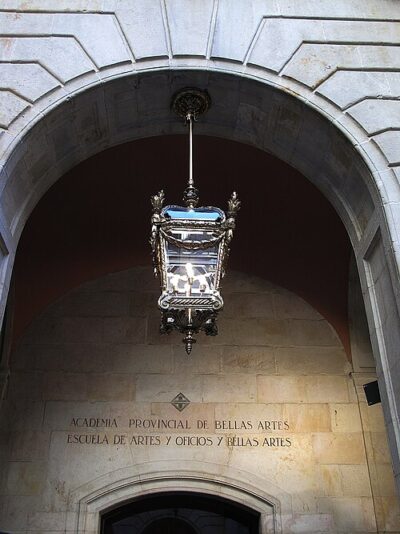
Picture: Enric, via Wikimedia Commons · CC BY-SA 4.0