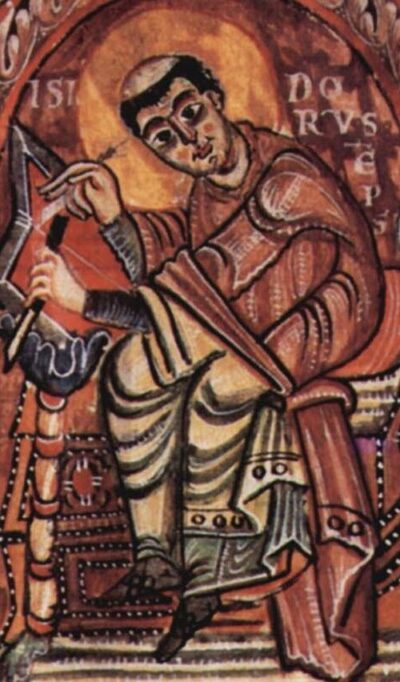
Etymologiae
Etymologiae is an etymological encyclopedia compiled by Isidore of Seville. It came out in 625.
- Published
- 625
- Written by
- Isidore of Seville
- Genre
- encyclopedia
- Country of origin
- Kingdom of Toledo
All 6 facts, and where they come from
Facts
6 facts · 0 confirmed by two sources · 0 cited · 6 from one source
Where this comes from
Papalocal keeps its own record. It started from these sources; what each one said is kept here as it was copied, so a change on their side never changes this page by itself. Tap one to read its version.
What Wikidata says · copied November 17, 2026 · revision 2520120196
- Described as
- etymological encyclopedia compiled by Isidore of Seville
- Other names
- Origines, Origins, Orig., The Etymologies, Etymologiarum sive originum libri XX, Originum sive etymologiarum libri XX
- What it is
- literary work
- Written by
- Isidore of Seville
- Genre
- encyclopedia
- Published
- 625
- Language
- medieval Latin
- Country of origin
- Kingdom of Toledo
- Wikipedias with a page
- 22
Wikidata item Q665934 (wikidata.org/wiki/Q665934), public domain (CC0). Copied 2026-11-17.
What Wikipedia says · copied November 17, 2026 · revision 1384741831
Etymologiae (Latin for 'Etymologies'), also known as the Origines ('Origins'), usually abbreviated Orig., is an etymological encyclopedia compiled by the influential Christian bishop Isidore of Seville (c. 560–636) towards the end of his life. Isidore was encouraged to write the book by his friend Braulio, Bishop of Saragossa. Etymologiae summarized and organized a wealth of knowledge from hundreds of classical sources; three of its books are derived largely from Pliny the Elder's Natural History. Isidore acknowledges Pliny, but not his other principal sources, namely Cassiodorus, Servius, and Gaius Julius Solinus.
Etymologiae covers an encyclopedic range of topics. Etymology, the origins of words, is prominent, but the work also covers, among other things, grammar, rhetoric, mathematics, geometry, music, astronomy, medicine, law, the church and heretical sects, pagan philosophers, languages, cities, humans, animals, the physical world, geography, public buildings, roads, metals, rocks, agriculture, war, ships, clothes, food, and tools.
Etymologiae was a widely used textbook throughout the Middle Ages. It was so popular that it was read in place of many of the original classics that it summarized; as a result, some of these ceased to be copied and were lost. It was cited by Dante Alighieri (who placed Isidore in his Paradiso), quoted by Geoffrey Chaucer, and mentioned by the poets Boccaccio, Petrarch, and John Gower. Among the thousand-odd surviving manuscript copies is the 13th-century Codex Gigas; the earliest surviving manuscript preserves a fragment of book XI from the 7th century. Etymologiae was printed in at least ten editions between 1472 and 1530, after which its importance faded during the Renaissance. The first scholarly edition was printed in Madrid in 1599; the first modern critical edition was edited by Wallace Lindsay in 1911.
While less well known in modern times, modern scholars recognize the work's importance in preserving both classical texts, as well as insight into the medieval mindset.
From the Wikipedia article “Etymologiae” (en.wikipedia.org/wiki/Etymologiae), by its contributors, under CC BY-SA 4.0 (creativecommons.org/licenses/by-sa/4.0/). Copied 2026-11-17; not changed.
Confirmed Two sources agree. Cited One source, and it names where it got it. One source One source, without a reference of its own. Sources disagree The sources disagree. We show the best-supported value and keep theirs below.
Picture: Wikimedia Commons: Isidoro di siviglia, etimologie, fine VIII secolo MSII 4856 Bruxelles, Bibliotheque Royale Albert I, 20x31,50, pagina in scrittura onciale carolina.jpg · See Commons file page