
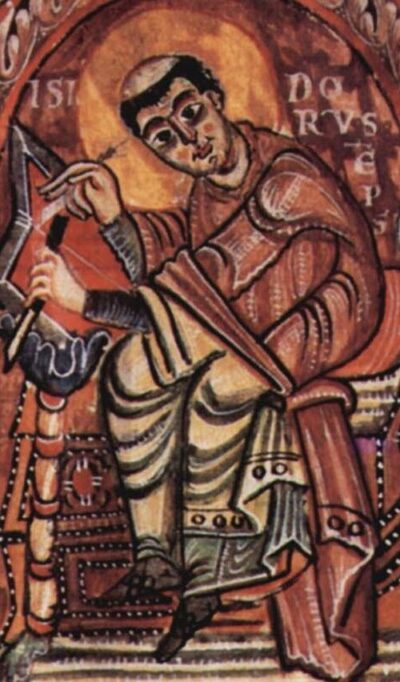
Isidore of Seville
Isidore of Seville was a Hispano-Roman scholar, theologian and bishop (c. 560–636). Born 560, in Cartagena. Died April 4, 636, in Spalis. Positions held include Roman Catholic Archbishop of Seville (600–636) and bishop. Known for Etymologiae, Historia de regibus Gothorum, Vandalorum et Suevorum and On illustrious men.
Facts
29 facts · 2 confirmed by two sources · 5 cited · 22 from one source
Where this comes from
Papalocal keeps its own record. It started from these sources; what each one said is kept here as it was copied, so a change on their side never changes this page by itself. Tap one to read its version.
What Wikidata says · copied November 16, 2026 · revision 2567829077
- Described as
- Hispano-Roman scholar, theologian and bishop (c. 560–636)
- Other names
- Saint Isidore of Seville, Isidor of Seville, St. Isidore, Bishop of Seville, Isidorus Hispalensis
- Born
- 560 · 2 references
- Died
- April 4, 636 · 1 reference
- Born in
- Cartagena · 1 reference
- Died in
- Spalis
- Citizen of
- Kingdom of Toledo
- Occupation
- writer · 1 reference; musicologist; philosopher; music theorist; Catholic priest; historian; polymath; Catholic bishop
- Positions held
- Roman Catholic Archbishop of Seville (600–636) · 1 reference; bishop · 1 reference
- Known for
- Etymologiae; Historia de regibus Gothorum, Vandalorum et Suevorum; On illustrious men; De natura rerum; De ortu et obitu patrum; De differentiis verborum; De differentiis rerum; De fide catholica contra Iudaeos; De ecclesiasticis officiis; Versus
- Siblings
- Florentina; Fulgentius of Cartagena; Leander of Seville · 1 reference
- Religion
- Catholic Church · 1 reference
- Wikipedias with a page
- 84
Wikidata item Q166876 (wikidata.org/wiki/Q166876), public domain (CC0). Copied November 16, 2026.
What Wikipedia says · copied November 16, 2026 · revision 1385558257
Isidore of Seville (Latin: Isidorus Hispalensis; c. 560 – 4 April 636) was a Hispano-Roman scholar, theologian and archbishop of Seville. He is widely regarded, in the words of the 19th-century historian Charles Forbes René de Montalembert, as "the last scholar of the ancient world".
At a time of disintegration of classical culture, aristocratic violence, and widespread illiteracy, Isidore was involved in the conversion of the Arian Visigothic kings to Catholicism, both assisting his brother Leander of Seville and continuing after Leander's death. He was influential in the inner circle of Sisebut, Visigothic king of Hispania. Like Leander, he played a prominent role in the Councils of Toledo and Seville.
His fame after his death was based on his Etymologiae, an etymological encyclopedia that assembled extracts of many books from classical antiquity that would otherwise have been lost. This work also helped to standardise the use of the full stop, comma and colon.
Since the Early Middle Ages, Isidore has sometimes been called Isidore the Younger or Isidore Junior (Latin: Isidorus iunior), because of the earlier history purportedly written by Isidore of Córdoba.
- Born, in its opening lines
- c. 560
- Died, in its opening lines
- April 4, 636
From the Wikipedia article “Isidore of Seville” (en.wikipedia.org/wiki/Isidore_of_Seville), by its contributors, under CC BY-SA 4.0 (creativecommons.org/licenses/by-sa/4.0/). Copied November 16, 2026; not changed.
Confirmed Two sources agree. Cited One source, and it names where it got it. One source One source, without a reference of its own. Sources disagree The sources disagree. We show the best-supported value and keep theirs below.
