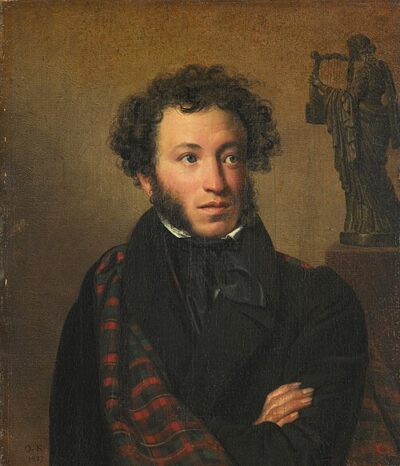
Eugene Onegin
Eugene Onegin is a novel in verse by Alexander Pushkin. It came out in 1825.
- Published
- 1825
- Came out
- 1823
- Written by
- Alexander Pushkin
- Genre
- verse novel
- Country of origin
- Russia
All 7 facts, and where they come from
Facts
7 facts · 0 confirmed by two sources · 0 cited · 7 from one source
Where this comes from
Papalocal keeps its own record. It started from these sources; what each one said is kept here as it was copied, so a change on their side never changes this page by itself. Tap one to read its version.
What Wikidata says · copied November 17, 2026 · revision 2549556318
- Described as
- novel in verse by Alexander Pushkin
- Other names
- Evgeny Onegin
- What it is
- literary work
- Written by
- Alexander Pushkin
- Genre
- verse novel
- Published
- 1825
- Language
- Russian
- Country of origin
- Russia
- Came out
- 1823
- Wikipedias with a page
- 70
Wikidata item Q50948 (wikidata.org/wiki/Q50948), public domain (CC0). Copied 2026-11-17.
What Wikipedia says · copied November 17, 2026 · revision 1385442836
Eugene Onegin, A Novel in Verse (Russian: Евгений Онегин, роман в стихах, romanized: Yevgeniy Onegin, roman v stikhakh, pre-reform Russian: Евгеній Онѣгинъ, романъ въ стихахъ, [jɪvˈɡʲenʲɪj ɐˈnʲeɡʲɪn]) is a novel in verse written by Alexander Pushkin. Onegin is considered a classic of Russian literature, and its eponymous protagonist has served as the model for a number of Russian literary heroes (so-called superfluous men). It was published in a serial form between 1825 and 1832. The first complete edition was published in 1833, and the currently accepted version is based on the 1837 publication.
Almost the entire work is made up of 389 fourteen-line stanzas (5,446 lines in all) of iambic tetrameter with the unusual rhyme scheme AbAbCCddEffEgg, where the uppercase letters represent feminine rhymes while the lowercase letters represent masculine rhymes. This original structure is known as the "Onegin stanza" or "Pushkin sonnet".
The story is told by a narrator (a lightly fictionalized version of Pushkin's public image), whose tone is educated, worldly, and intimate. The narrator digresses at times, usually to expand on aspects of this social and intellectual world. This narrative style allows for a development of the characters and emphasizes the drama of the plot despite its relative simplicity. The book is admired for the artfulness of its verse narrative as well as for its exploration of life, death, love, ennui, convention, and passion.
From the Wikipedia article “Eugene Onegin” (en.wikipedia.org/wiki/Eugene_Onegin), by its contributors, under CC BY-SA 4.0 (creativecommons.org/licenses/by-sa/4.0/). Copied 2026-11-17; not changed.
Confirmed Two sources agree. Cited One source, and it names where it got it. One source One source, without a reference of its own. Sources disagree The sources disagree. We show the best-supported value and keep theirs below.
Picture: Wikimedia Commons: Eugene Onegin book edition.jpg · See Commons file page