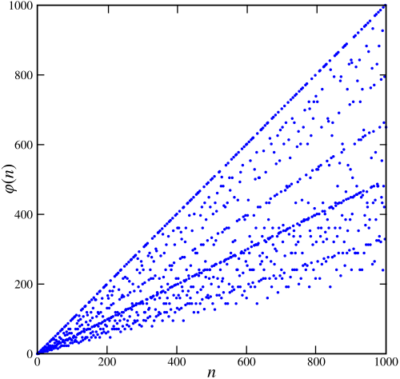
Euler's totient function
Euler's totient function is a function which gives the number of integers relatively prime to and not greater than its input.
All 4 facts, and where they come from
Facts
4 facts · 0 confirmed by two sources · 0 cited · 4 from one source
Where this comes from
Papalocal keeps its own record. It started from these sources; what each one said is kept here as it was copied, so a change on their side never changes this page by itself. Tap one to read its version.
What Wikidata says · copied November 17, 2026 · revision 2531394612
- Described as
- function which gives the number of integers relatively prime to and not greater than its input
- Other names
- phi function, Euler phi function, Euler totient function, totient function
- What it is
- function; arithmetic function; multiplicative function
- Named after
- Leonhard Euler
- Wikipedias with a page
- 45
Wikidata item Q190026 (wikidata.org/wiki/Q190026), public domain (CC0). Copied 2026-11-17.
What Wikipedia says · copied November 17, 2026 · revision 1383434124
In number theory, Euler's totient function counts the positive integers up to a given integer n that are relatively prime to n. It is written using the Greek letter phi as φ(n) or ϕ(n), and may also be called Euler's phi function. In other words, it is the number of integers k in the range 1≤k≤n for which the greatest common divisor gcd(n,k) is equal to 1. The integers k of this form are sometimes referred to as totatives of n.
For example, the totatives of n=9 are the six numbers 1, 2, 4, 5, 7 and 8. They are all relatively prime to 9, but the other three numbers in this range, 3, 6, and 9 are not, since gcd(9,3)=gcd(9,6)=3 and gcd(9,9)=9. Therefore, φ(9)=6. As another example, φ(1)=1 since for n=1 the only integer in the range from 1 to n is 1 itself, and gcd(1,1)=1.
Euler's totient function is a multiplicative function, meaning that if two numbers m and n are relatively prime, then φ(mn)=φ(m)φ(n).
This function gives the order of the multiplicative group of integers modulo n (the group of units of the ring ℤ/nℤ). It is also used for defining the RSA encryption system.
From the Wikipedia article “Euler's totient function” (en.wikipedia.org/wiki/Euler's_totient_function), by its contributors, under CC BY-SA 4.0 (creativecommons.org/licenses/by-sa/4.0/). Copied 2026-11-17; not changed.
Confirmed Two sources agree. Cited One source, and it names where it got it. One source One source, without a reference of its own. Sources disagree The sources disagree. We show the best-supported value and keep theirs below.
Picture: Pietro Battiston (it:User:Toobaz), via Wikimedia Commons · CC BY-SA 4.0