
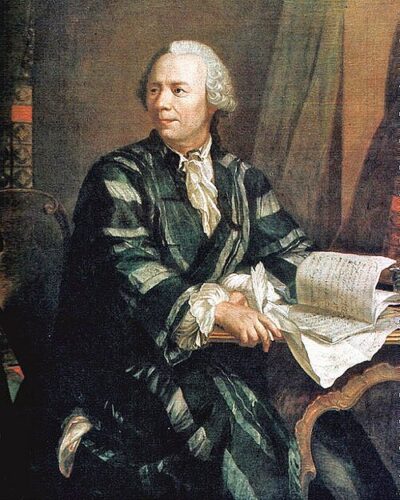
Leonhard Euler
Leonhard Euler was a Swiss mathematician, physicist, and engineer. Born April 15, 1707, in Basel. Died September 18, 1783, in Saint Petersburg. Positions held include adjunct (1727–1730) and professor (2 times) (1731–). Known for Euler's theorem, Euler's rotation theorem and Euler's theorem in geometry. Educated at University of Basel.
Facts
60 facts · 2 confirmed by two sources · 27 cited · 31 from one source
Where this comes from
Papalocal keeps its own record. It started from these sources; what each one said is kept here as it was copied, so a change on their side never changes this page by itself. Tap one to read its version.
What Wikidata says · copied November 16, 2026 · revision 2569999707
- Described as
- Swiss mathematician, physicist, and engineer (1707–1783)
- Other names
- L. Euler, Euler, Euler, Leonhard, Leonhard Paul Euler
- Born
- April 15, 1707 · 17 references
- Died
- September 18, 1783 · 14 references
- Born in
- Basel · 7 references
- Died in
- Saint Petersburg · 4 references
- Buried in
- Smolensky Lutheran Cemetery (–1957) · 1 reference; Lazarev Cemetery (1957–)
- Cause of death
- cerebral hemorrhage
- Citizen of
- Old Swiss Confederacy · 1 reference; Russian Empire; Kingdom of Prussia
- Occupation
- mathematician · 4 references; physicist · 3 references; university teacher · 1 reference; writer · 2 references; music theorist · 1 reference; astronomer · 5 references; scientist · 1 reference; inventor · 1 reference
- Positions held
- adjunct (1727–1730) · 1 reference; professor (2 times) (1731–) · 1 reference
- Worked for
- Royal Prussian Academy of Sciences; Saint Petersburg State University · 1 reference; Saint Petersburg Academy of Sciences (2 times) (1727–)
- Education
- University of Basel (1720–) · 2 references
- Member of
- Royal Prussian Academy of Sciences (1741–) · 1 reference; Royal Swedish Academy of Sciences; Saint Petersburg Academy of Sciences (1730–) · 1 reference; French Academy of Sciences (1755–) · 1 reference; American Academy of Arts and Sciences (1782–) · 1 reference; Royal Society of London (1747–) · 1 reference; Academy of Sciences of Turin (1760–) · 1 reference
- Known for
- Euler's theorem; Euler's rotation theorem; Euler's theorem in geometry; Euler's sum of powers conjecture; Euler's polyhedron formula; Euler–Lagrange equation; Cauchy–Euler equation; Euler's totient function; Euler's identity; Euler's four-square identity
- Field
- mathematical analysis · 2 references; number theory · 1 reference; shipbuilding · 1 reference; calculus of variations · 1 reference; astronomy · 2 references; mechanics · 2 references
- Spouse
- Salomea Abigail Euler (1776–) · 1 reference; Katharina Euler (1734–1773) · 3 references
- Children
- Johann Euler · 1 reference; Christoph Euler; Carl Euler · 1 reference; Charlotte Euler
- Father
- Paul III Euler · 1 reference
- Mother
- Marguerite Brucker · 1 reference
- Religion
- Protestantism · 1 reference; reformed · 1 reference
- Lived in
- Basel; Saint Petersburg (2 times) (1727–); Berlin (1741–1753)
- Wikipedias with a page
- 192
Wikidata item Q7604 (wikidata.org/wiki/Q7604), public domain (CC0). Copied November 16, 2026.
What Wikipedia says · copied November 16, 2026 · revision 1385567113
Leonhard Euler ( OY-lər; 15 April 1707 – 18 September 1783) was a Swiss polymath who was active as a mathematician, physicist, astronomer, logician, geographer, music theorist and engineer. He founded the studies of graph theory and topology and made influential discoveries in many other branches of mathematics, such as analytic number theory, complex analysis, and infinitesimal calculus. He also introduced much of modern mathematical terminology and notation, including the notion of a mathematical function. He is known for his work in mechanics, fluid dynamics, optics, astronomy, and music theory. Euler has been called a "universal genius" who "was fully equipped with almost unlimited powers of imagination, intellectual gifts and extraordinary memory". He spent most of his adult life in Saint Petersburg, Russia, and in Berlin, then the capital of Prussia.
Euler is credited for popularizing the Greek letter π (lowercase pi) to denote the ratio of a circle's circumference to its diameter, as well as first using the notation f(x) for the value of a function, the letter i to express the imaginary unit −1, the Greek letter Σ (capital sigma) to express summations, the Greek letter Δ (capital delta) for finite differences, and lowercase letters to represent the sides of a triangle while representing the angles as capital letters. He gave the current definition of the constant e, the base of the natural logarithm, now known as Euler's number. Euler made contributions to applied mathematics and engineering, such as his study of ships helping navigation, his three volumes on optics, which contributed to the design of microscopes and telescopes, and his studies of beam bending and column critical loads.
Euler is credited with being the first to develop graph theory (partly as a solution for the problem of the Seven Bridges of Königsberg, which is also considered the first practical application of topology). He also became famous for, among many other accomplishments, solving several unsolved problems in number theory and analysis, including the famous Basel problem. Euler has also been credited for discovering that the sum of the numbers of vertices and faces minus the number of edges of a polyhedron that has no holes equals 2, a number now commonly known as the Euler characteristic. In physics, Euler reformulated Isaac Newton's laws of motion into new laws in his two-volume work Mechanica to better explain the motion of rigid bodies. He contributed to the study of elastic deformations of solid objects. Euler formulated the partial differential equations for the motion of inviscid fluid, and laid the mathematical foundations of potential theory.
Euler is regarded as arguably the most prolific contributor in the history of mathematics and science, and the greatest mathematician of the 18th century. His 866 publications and his correspondence were collected in the Opera Omnia Leonhard Euler. Several great mathematicians who worked after Euler's death have recognised his importance in the field: Pierre-Simon Laplace said, "Read Euler, read Euler, he is the master of us all"; Carl Friedrich Gauss wrote: "The study of Euler's works will remain the best school for the different fields of mathematics, and nothing else can replace it."
- Born, in its opening lines
- April 15, 1707
- Died, in its opening lines
- September 18, 1783
From the Wikipedia article “Leonhard Euler” (en.wikipedia.org/wiki/Leonhard_Euler), by its contributors, under CC BY-SA 4.0 (creativecommons.org/licenses/by-sa/4.0/). Copied November 16, 2026; not changed.
Confirmed Two sources agree. Cited One source, and it names where it got it. One source One source, without a reference of its own. Sources disagree The sources disagree. We show the best-supported value and keep theirs below.
