Faddeev–LeVerrier algorithm
Faddeev–LeVerrier algorithm is a Mathematical algorithm.
All 3 facts, and where they come from
Facts
3 facts · 0 confirmed by two sources · 1 cited · 2 from one source
Where this comes from
Papalocal keeps its own record. It started from these sources; what each one said is kept here as it was copied, so a change on their side never changes this page by itself. Tap one to read its version.
What Wikidata says · copied November 17, 2026 · revision 2559455221
- Described as
- Mathematical algorithm
- What it is
- recursion
- Named after
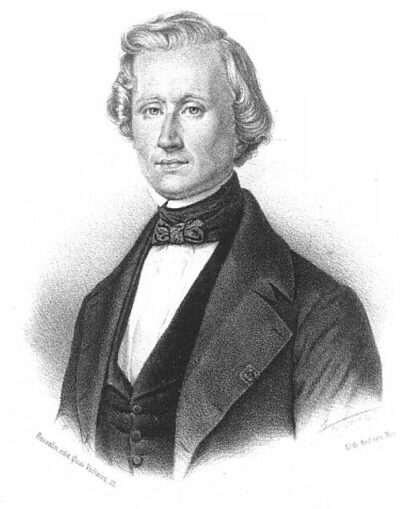
- Dmitry Faddeev; Urbain Le Verrier · 1 reference
- Wikipedias with a page
- 4
Wikidata item Q1484649 (wikidata.org/wiki/Q1484649), public domain (CC0). Copied 2026-11-17.
What Wikipedia says · copied November 17, 2026 · revision 1369300907
In mathematics (linear algebra), the Faddeev–LeVerrier algorithm is a recursive method to calculate the coefficients of the characteristic polynomial pA(λ)=det(λIn−A) of a square matrix, A, named after Dmitry Konstantinovich Faddeev and Urbain Le Verrier. Calculation of this polynomial yields the eigenvalues of A as its roots; as a matrix polynomial in the matrix A itself, it vanishes by the Cayley–Hamilton theorem. Computing the characteristic polynomial directly from the definition of the determinant is computationally cumbersome insofar as it introduces a new symbolic quantity λ; by contrast, the Faddeev-Le Verrier algorithm works directly with coefficients of matrix A.
The algorithm has been independently rediscovered several times in different forms. It was first published in 1840 by Urbain Le Verrier, subsequently redeveloped by P. Horst, Jean-Marie Souriau, in its present form here by Faddeev and Sominsky, and further by J. S. Frame, and others. (For historical points, see Householder. An elegant shortcut to the proof, bypassing Newton polynomials, was introduced by Hou. The bulk of the presentation here follows Gantmacher, p. 88.)
From the Wikipedia article “Faddeev–LeVerrier algorithm” (en.wikipedia.org/wiki/Faddeev–LeVerrier_algorithm), by its contributors, under CC BY-SA 4.0 (creativecommons.org/licenses/by-sa/4.0/). Copied 2026-11-17; not changed.
Confirmed Two sources agree. Cited One source, and it names where it got it. One source One source, without a reference of its own. Sources disagree The sources disagree. We show the best-supported value and keep theirs below.