
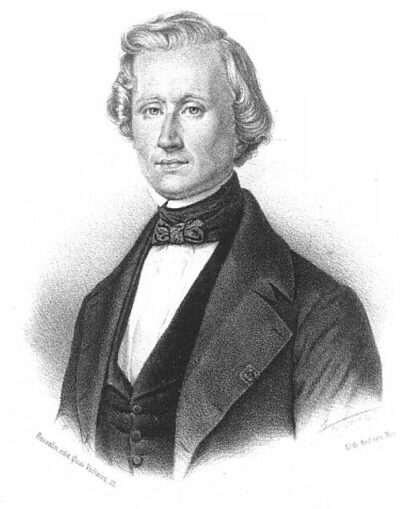
Urbain Le Verrier
Urbain Le Verrier was a French astronomer. Born March 11, 1811, in Saint-Lô. Died September 23, 1877, in Paris. Positions held include member of the French National Assembly (1849–1851), member of the general council (1852–1869) and Second Empire senator (1852–1870). Known for discovery of Neptune and Faddeev–LeVerrier algorithm. Educated at École polytechnique and Muséum national d'histoire naturelle. Awards include Copley Medal, Officer of the Legion of Honour and Gold Medal of the Royal Astronomical Society.
Facts
44 facts · 2 confirmed by two sources · 25 cited · 17 from one source
Where this comes from
Papalocal keeps its own record. It started from these sources; what each one said is kept here as it was copied, so a change on their side never changes this page by itself. Tap one to read its version.
What Wikidata says · copied November 16, 2026 · revision 2567768864
- Described as
- French astronomer (1811-1877)
- Other names
- Urbain Jean Joseph Le Verrier, U.-J. (Urbain J.) Le Verrier, Urban Jean Joseph Leverrier
- Born
- March 11, 1811 · 12 references
- Died
- September 23, 1877 · 11 references
- Born in
- Saint-Lô · 6 references
- Died in
- Paris · 4 references
- Buried in
- Montparnasse Cemetery · 1 reference
- Name at birth
- Urbain Jean Joseph Le Verrier · 1 reference
- Citizen of
- France · 4 references
- Occupation
- astronomer · 4 references; mathematician · 2 references; politician · 1 reference; meteorologist · 1 reference; writer · 1 reference
- Positions held
- member of the French National Assembly (1849–1851) · 1 reference; member of the general council (1852–1869) · 1 reference; Second Empire senator (1852–1870) · 1 reference; director (2 times) (1854–1877) · 1 reference
- Worked for
- École polytechnique (1836–1854) · 1 reference; Paris Observatory, PSL University (1854–1877) · 1 reference; University of Paris (1847–1854) · 1 reference
- Education
- École polytechnique (1831–1833) · 1 reference; Muséum national d'histoire naturelle (1833–1836) · 1 reference; Lycée François de Malherbe (1827–1830) · 1 reference
- Member of
- Société Philomathique de Paris; Royal Swedish Academy of Sciences; French Academy of Sciences; Royal Society of London; American Academy of Arts and Sciences; Russian Academy of Sciences; Royal Prussian Academy of Sciences; German Academy of Sciences Leopoldina; Accademia Nazionale delle Scienze detta dei XL; Bavarian Academy of Sciences and Humanities
- Known for
- discovery of Neptune; Faddeev–LeVerrier algorithm
- Awards
- Copley Medal (1846) · 1 reference; Officer of the Legion of Honour (1846) · 1 reference; Gold Medal of the Royal Astronomical Society (1868) · 1 reference; Concours général (1831) · 1 reference; Fellow of the American Academy of Arts and Sciences (1847) · 1 reference; Foreign Member of the Royal Society (1847) · 1 reference; 72 names on the Eiffel Tower · 1 reference
- Field
- celestial mechanics; astronomy
- Spouse
- Lucille Clotilde Choquet · 1 reference
- Wikipedias with a page
- 72
Wikidata item Q104154 (wikidata.org/wiki/Q104154), public domain (CC0). Copied November 16, 2026.
What Wikipedia says · copied November 16, 2026 · revision 1383535673
Urbain Jean Joseph Le Verrier (French: [yʁbɛ̃ ʒɑ̃ ʒozɛf lə vɛʁje]; 11 March 1811 – 23 September 1877) was a French astronomer and celestial mechanician. and is best known for predicting the existence and position of Neptune using only mathematics.
The calculations were made to explain discrepancies with Uranus's orbit and the laws of Johannes Kepler and Isaac Newton. Le Verrier sent the coordinates to Johann Gottfried Galle in Berlin, asking him to verify. Galle found Neptune the same night he received Le Verrier's letter, within 1° of the predicted position.
The discovery of Neptune is widely regarded as a dramatic validation of celestial mechanics, and is one of the most remarkable moments of 19th-century science.
- Born, in its opening lines
- March 11, 1811
- Died, in its opening lines
- September 23, 1877
From the Wikipedia article “Urbain Le Verrier” (en.wikipedia.org/wiki/Urbain_Le_Verrier), by its contributors, under CC BY-SA 4.0 (creativecommons.org/licenses/by-sa/4.0/). Copied November 16, 2026; not changed.
Confirmed Two sources agree. Cited One source, and it names where it got it. One source One source, without a reference of its own. Sources disagree The sources disagree. We show the best-supported value and keep theirs below.
