Falstaff
Falstaff is a 1893 opera by Giuseppe Verdi. It came out in 1889. It is based on Henry IV.
- Released
- 19th century
- Came out
- 1889
- Genre
- commedia lirica
- Country of origin
- Italy
All 11 facts, and where they come from
Facts
11 facts · 0 confirmed by two sources · 3 cited · 8 from one source
Where this comes from
Papalocal keeps its own record. It started from these sources; what each one said is kept here as it was copied, so a change on their side never changes this page by itself. Tap one to read its version.
What Wikidata says · copied November 17, 2026 · revision 2520576309
- Described as
- 1893 opera by Giuseppe Verdi
- What it is
- dramatico-musical work
- Music by
- Giuseppe Verdi · 1 reference
- Screenplay by
- William Shakespeare · 1 reference
- Genre
- commedia lirica; opera · 1 reference
- Released
- 19th century
- Language
- Italian
- Country of origin
- Italy
- Based on
- Henry IV; The Merry Wives of Windsor
- Came out
- 1889
- Wikipedias with a page
- 42
Wikidata item Q318455 (wikidata.org/wiki/Q318455), public domain (CC0). Copied 2026-11-17.
What Wikipedia says · copied November 17, 2026 · revision 1375305741
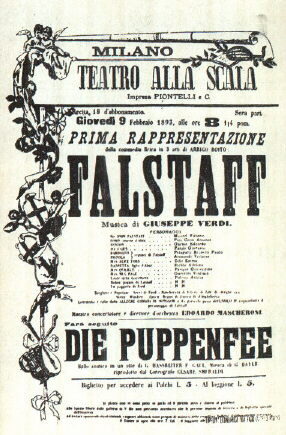
Falstaff (Italian pronunciation: [ˈfalstaf]) is a comic opera in three acts by the Italian composer Giuseppe Verdi. The Italian-language libretto was adapted by Arrigo Boito from the play The Merry Wives of Windsor and scenes from Henry IV, Part 1 and Part 2, by William Shakespeare. The work premiered on 9 February 1893 at La Scala, Milan.
Verdi wrote Falstaff, the last of his 26 operas, as he approached the age of 80. It was his second comedy, and his third work based on a Shakespeare play, following Macbeth and Otello. The plot revolves around the thwarted, sometimes farcical, efforts of the fat knight Sir John Falstaff to seduce two married women to gain access to their husbands' wealth.
Verdi was concerned about working on a new opera at his advanced age, but he yearned to write a comic work and was pleased with Boito's draft libretto. It took the collaborators three years from mid-1889 to complete. Although the prospect of a new opera from Verdi aroused immense interest in Italy and around the world, Falstaff did not prove to be as popular as earlier works in the composer's canon. After the initial performances in Italy, other European countries and the US, the work was neglected until the conductor Arturo Toscanini insisted on its revival at La Scala and the Metropolitan Opera in New York from the late 1890s into the next century. Some felt that the piece suffered from a lack of the full-blooded melodies of the best of Verdi's previous operas, a view that Toscanini strongly opposed. Conductors of the generation after Toscanini who championed the work included Herbert von Karajan, Georg Solti and Leonard Bernstein. The work is now part of the standard operatic repertory.
Verdi made numerous changes to the music after the first performance, and editors have found difficulty in agreeing on a definitive score. The work was first recorded in 1932 and has subsequently received many studio and live recordings. Singers closely associated with the title role have included Victor Maurel (the first Falstaff), Mariano Stabile, Giuseppe Valdengo, Tito Gobbi, Geraint Evans, Bryn Terfel and Ambrogio Maestri.
From the Wikipedia article “Falstaff (opera)” (en.wikipedia.org/wiki/Falstaff_(opera)), by its contributors, under CC BY-SA 4.0 (creativecommons.org/licenses/by-sa/4.0/). Copied 2026-11-17; not changed.
Confirmed Two sources agree. Cited One source, and it names where it got it. One source One source, without a reference of its own. Sources disagree The sources disagree. We show the best-supported value and keep theirs below.
Picture: Неизвестны, via Wikimedia Commons · Public domain